










Maisa AI Raises $25M to Tackle Enterprise AI’s 95% Failure Rate
The promise of generative AI has sparked excitement across industries, but a recent report from MIT’s NANDA initiative has revealed a sobering reality: 95% of enterprise AI pilots are failing. Many organizations find that their experiments with generative models lead to inconsistent results, unreliable outputs, and costly inefficiencies. Yet instead of abandoning AI altogether, the most forward-thinking companies are pivoting toward a new frontier — agentic AI systems designed for accountability and trust.
This is where Maisa AI, a rapidly growing startup, is making its mark. Founded in 2024, the company has just raised a $25 million seed funding round, led by European VC firm Creandum, to bring its vision of accountable enterprise automation to life.
Why Enterprise AI Needs a Different Approach
For enterprises, deploying AI is not about experimentation — it’s about execution. Rigid RPA (Robotic Process Automation) tools have long been used for automation, but they lack flexibility. Meanwhile, traditional generative AI models often operate as “black boxes”, producing answers without transparency.
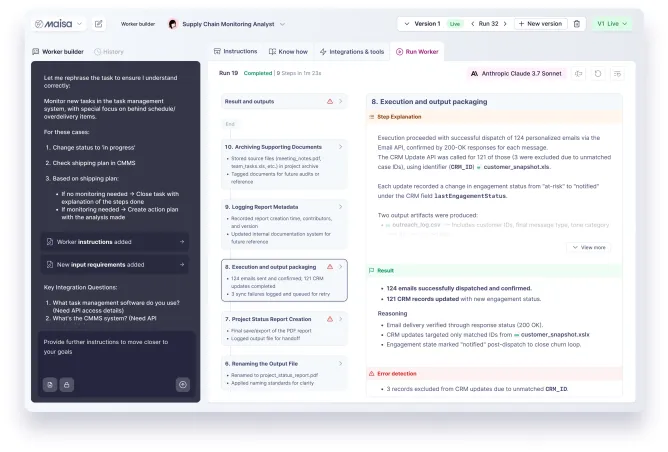
Maisa AI challenges both models. Instead of generating outputs directly, its system creates “chains of work” — structured processes that show exactly how an AI-driven digital worker arrives at an outcome. This makes it possible for businesses to track, audit, and refine AI-driven workflows without losing oversight.
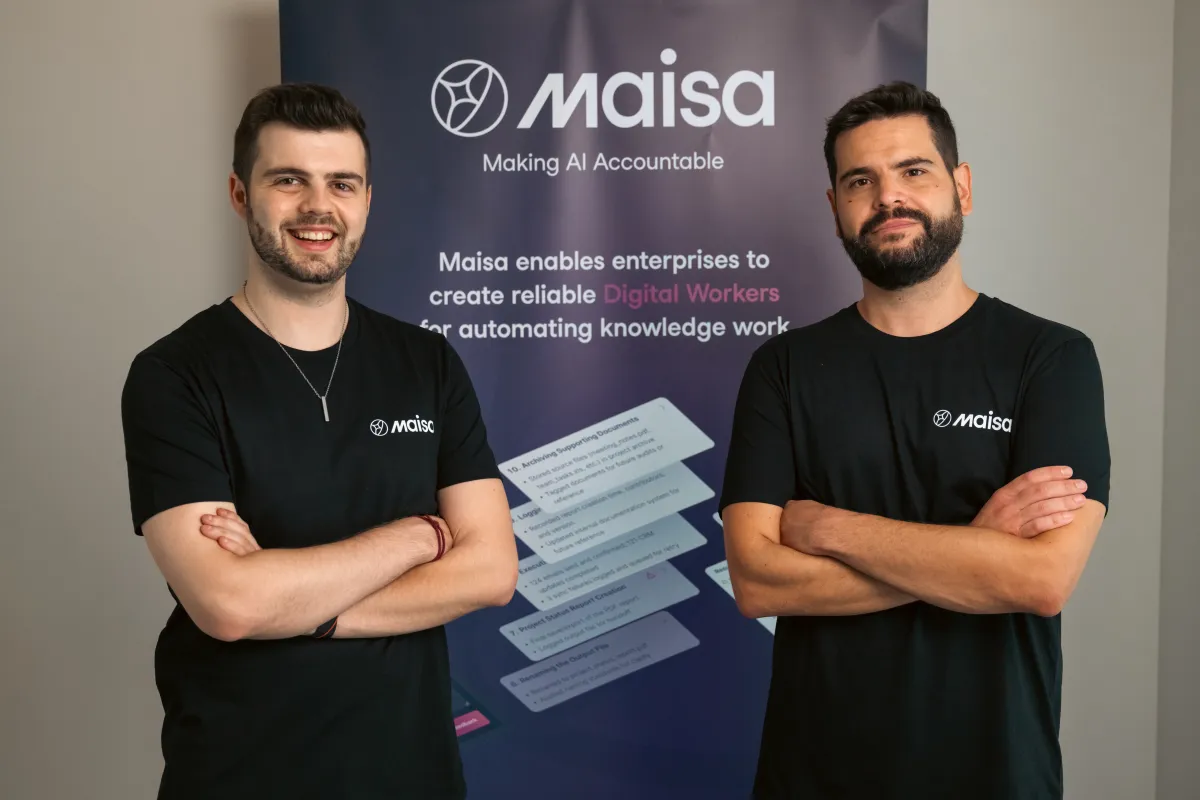
“Our goal is not just to provide answers,” said CEO David Villalón, who co-founded Maisa alongside Chief Scientific Officer Manuel Romero. “We’re designing AI that builds the process needed to achieve the right outcome — with full accountability at every step.”
The Technology Behind Maisa AI
Maisa’s enterprise-first platform, Maisa Studio, introduces two key innovations that separate it from competitors:
- HALP (Human-Augmented LLM Processing): Instead of letting AI run unchecked, HALP allows users to guide and validate processes in real time. Think of it as a classroom exercise where the “digital worker” shows its work, and the human can intervene if something looks off.
- KPU (Knowledge Processing Unit): A deterministic system that reduces AI “hallucinations” by enforcing consistent and reliable outputs.
These frameworks ensure that Maisa’s AI agents remain auditable, trustworthy, and scalable. The company has already attracted enterprise clients in banking, automotive manufacturing, and energy — industries where security, compliance, and trust are non-negotiable.
Funding, Growth, and Market Position
Maisa AI’s $25 million seed round follows a $5 million pre-seed investment secured in late 2024, led by San Francisco-based firms NFX and Village Global. The new round includes participation from Forgepoint Capital International, which partnered with Banco Santander, signaling strong confidence from investors who specialize in regulated sectors.
The startup maintains dual headquarters in Valencia and San Francisco, giving it both a European foundation and a foothold in the U.S. market. This positioning is key as enterprises across both regions push to scale AI in high-stakes environments.
Maisa plans to expand its team from 35 to 65 employees by early 2026 to meet rising demand. Beginning later this year, it expects rapid growth as it starts onboarding clients from its waiting list.
Competing in the Enterprise AI Landscape
Maisa AI is not alone in its pursuit of accountable automation. Rivals such as Crew AI and other workflow automation platforms are also vying for enterprise attention. But Villalón argues that Maisa’s unique framework offers something competitors lack: a balance of flexibility and accountability.
In a recent statement, Villalón warned that while many AI frameworks promise “quick starts,” they often lead to “long nightmares” when businesses face reliability issues, lack of transparency, or the inability to fix errors. Maisa’s approach aims to prevent these pitfalls by combining trust, auditability, and scalability from the ground up.
A New Era of Enterprise Automation
For organizations navigating digital transformation, Maisa AI offers more than automation — it offers assurance. By deploying AI agents that explain their steps, avoid hallucinations, and adapt to specific workflows, Maisa provides a framework for enterprise AI adoption that is reliable, secure, and future-proof.
“Our mission is simple,” Villalón emphasized. “We are going to show the market that there is a company delivering what AI has promised — and proving that it works in real-world, mission-critical environments.”
Final Thoughts
The road to enterprise-wide AI adoption has been riddled with failures, but Maisa AI’s $25 million raise signals a shift in focus. With its emphasis on transparency, accountability, and enterprise automation at scale, the startup is positioning itself as a serious contender in the next wave of AI-driven business transformation.
As more organizations seek to harness AI for high-value, regulated, and complex tasks, solutions like Maisa Studio may prove essential in turning ambitious pilots into successful, long-term strategies.