








Introduction
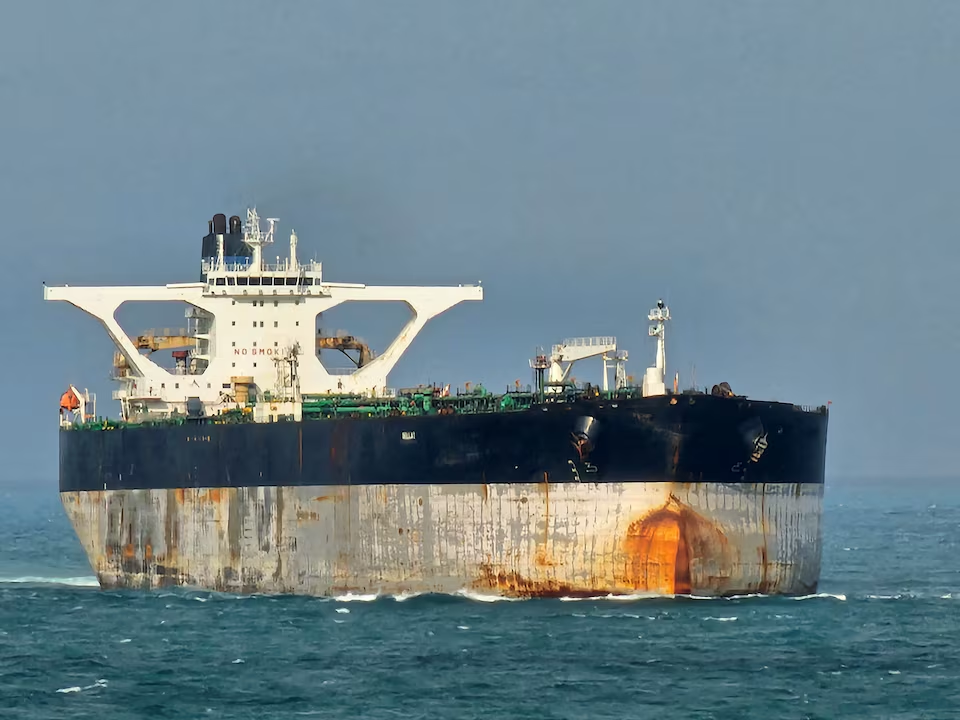
The U.S. blockade of Venezuelan oil has quietly evolved from a sanctions policy into a test case for modern maritime power. Recent U.S. efforts to seize a Venezuela-linked oil tanker flying a Russian flag—reportedly under the watch of Russian naval assets—suggest that energy sanctions are no longer confined to financial systems or diplomatic pressure.
Instead, they are being enforced physically, at sea, across jurisdictions, and in ways that blur the line between economic coercion and military signaling.
The key question is no longer whether sanctions work—but what kind of global order emerges when they are enforced through forceful maritime intervention.
Background Context: From Sanctions to Sea Control
U.S. energy sanctions on Venezuela, first imposed in 2019, were designed to cut off revenue streams supporting the Maduro government. Over time, these sanctions expanded into a de facto maritime enforcement regime aimed at preventing Venezuelan crude from reaching global markets—particularly China.
In response, Venezuela and its trading partners adopted evasive strategies common to sanctioned states:
- Use of reflagged vessels
- Transponder shutdowns (“dark mode”)
- Reliance on a loosely coordinated “shadow fleet”
- Ship-to-ship transfers in international waters
What is new is how aggressively the United States is now enforcing compliance, including attempted vessel seizures far from U.S. territorial waters and against ships flying the flag of major powers.
Why This Matters Now
The attempted seizure of a Russian-flagged tanker linked to Venezuelan oil exports represents more than an isolated enforcement action. It signals a shift toward active interdiction—a model historically associated with wartime blockades, not peacetime sanctions.
This raises three immediate issues:
- Legal ambiguity around jurisdiction and freedom of navigation
- Strategic risk involving great-power military proximity
- Precedent-setting behavior for future sanctions regimes
The U.S. blockade of Venezuelan oil is thus becoming a stress test for the international maritime system itself.
Strategic Benefits for the United States
From Washington’s perspective, the escalation offers several advantages.
1. Sanctions Credibility
Financial sanctions are only effective if they are enforceable. Shadow fleets thrive on the assumption that enforcement will be inconsistent. Physical interdiction challenges that assumption and may deter future evasion.
2. Geopolitical Leverage
By disrupting Venezuelan oil flows to China, the U.S. gains leverage not only over Caracas but also over Beijing’s energy supply diversification strategy.
3. Domestic Political Signaling
A hardline approach reinforces narratives of strength, deterrence, and control over strategic resources—especially in an election-sensitive environment.
In short, the U.S. blockade of Venezuelan oil is being used as a tool of geopolitical signaling, not merely economic pressure.
Risks and Limitations of Maritime Enforcement
Despite its tactical appeal, this approach carries significant risks.
Legal Uncertainty
International maritime law strongly protects freedom of navigation. While sanctions regimes justify enforcement actions, the seizure of foreign-flagged vessels in international waters remains legally contentious, especially when those vessels belong to states not party to the sanctions.
This ambiguity weakens the normative foundation of sanctions enforcement.
Escalation with Major Powers
The presence of Russian naval assets near enforcement operations introduces escalation risks that sanctions policy was never designed to manage. Even absent confrontation, proximity increases the probability of miscalculation.
Sanctions are meant to be coercive—but not destabilizing.
Enforcement Fatigue
Sustained maritime operations are resource-intensive. Over time, the cost of maintaining a blockade-like posture may outweigh its economic impact, especially if sanctioned states adapt faster than enforcement mechanisms.
Ethical and Policy Implications
The U.S. blockade of Venezuelan oil raises deeper ethical questions that extend beyond Venezuela itself.
Collective Punishment Concerns
Oil revenue restrictions directly affect civilian welfare in already fragile economies. While sanctions target governments, their humanitarian spillover is well documented and ethically contested.
Selective Enforcement
Critics note that sanctions enforcement is often inconsistent, shaped by strategic interests rather than universal principles. This perception undermines claims of rule-based order.
Militarization of Economic Policy
As sanctions increasingly rely on military and coast guard assets, economic policy risks becoming indistinguishable from security doctrine—reducing diplomatic flexibility.
Global and Future Implications
If this enforcement model becomes normalized, several long-term trends may accelerate:
- Fragmentation of global shipping norms, with rival enforcement regimes
- Expansion of shadow fleets, operating outside insurance and regulatory systems
- Increased naval involvement in economic disputes, particularly around energy
For emerging economies, the lesson may be clear: strategic autonomy requires alternative logistics, currencies, and alliances.
The U.S. blockade of Venezuelan oil may therefore contribute to the very parallel systems it seeks to suppress.
Scholarly Perspective: Sanctions as Power Projection
Academic research on sanctions consistently shows that their effectiveness depends less on severity and more on legitimacy, coordination, and enforcement coherence.
Political economists warn that when sanctions rely too heavily on coercive enforcement, they risk:
- Eroding international legal norms
- Encouraging counter-coalitions
- Incentivizing technological and logistical workarounds
From this perspective, the current trajectory reflects not sanctions strength—but institutional strain in the global order.
Conclusion: Enforcement or Overreach?
The attempted seizure of Venezuela-linked oil tankers illustrates how the U.S. blockade of Venezuelan oil has crossed into new strategic territory. It is no longer just about denying revenue—it is about asserting control over energy flows, maritime space, and geopolitical signaling.
Whether this represents effective enforcement or dangerous overreach remains unresolved.
What is clear is that sanctions are no longer silent instruments of economic pressure. They are becoming visible, contested, and increasingly enforced at sea—where the consequences of misjudgment are far harder to contain.
Is this the future of sanctions—or the beginning of their unraveling?