








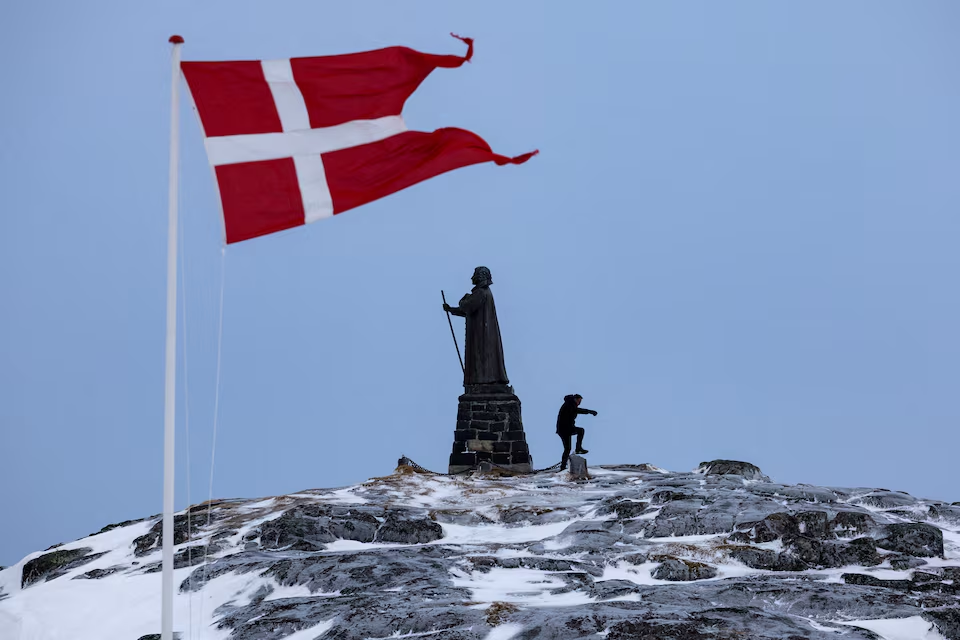
The Greenland geopolitical crisis has moved from speculative diplomacy into a serious strategic concern as European allies quietly prepare contingency plans in response to renewed signals from the United States. Reports that France, Germany, and other European partners are coordinating a response to potential U.S. action over Greenland reflect not panic, but realism: Greenland now sits at the intersection of global security, Arctic resources, and great-power rivalry.
At the heart of the Greenland geopolitical crisis lies a fundamental question many policymakers hesitate to ask publicly: can territorial sovereignty still be challenged by powerful allies in the 21st century? The issue is no longer whether Greenland is strategically important—this has been clear for decades—but whether traditional alliances can withstand unilateral ambitions driven by security, resources, and geopolitical positioning.
Greenland Geopolitical Crisis and the Strategic Value of Greenland
To understand the Greenland geopolitical crisis, one must first understand why Greenland matters. Geographically, Greenland occupies a commanding position in the Arctic, bridging North America and Europe. Militarily, it hosts critical early-warning and missile-defense infrastructure, notably the U.S. Thule Air Base, which plays a vital role in North American defense systems.
Beyond security, the Greenland geopolitical crisis is deeply tied to natural resources. Greenland is believed to hold vast reserves of rare earth elements, uranium, oil, and gas—resources increasingly vital for advanced technologies and energy transitions. As Arctic ice melts, new shipping routes and access to previously unreachable resources further elevate Greenland’s importance.
In this context, Greenland is not merely territory; it is leverage. Control over Greenland would grant immense strategic advantage in Arctic governance, global trade routes, and technological supply chains.
The Greenland Geopolitical Crisis and U.S. Strategic Ambitions
The Greenland geopolitical crisis escalated significantly when U.S. President Donald Trump openly expressed interest in acquiring Greenland during his presidency—remarks initially dismissed as unconventional but later reassessed as strategically coherent. From a U.S. defense perspective, Greenland represents a natural extension of continental security and Arctic dominance.
Renewed concern among European allies suggests that these ambitions have not fully disappeared. Even without formal annexation, increased U.S. pressure, expanded military presence, or economic leverage could alter Greenland’s status in practice if not in name.
This is where the Greenland geopolitical crisis becomes sensitive: when a security guarantor appears willing to override allied sovereignty, alliance norms are strained.
European Response to the Greenland Geopolitical Crisis: Why France and Germany Are Alarmed
European coordination around the Greenland geopolitical crisis is not accidental. France and Germany, long advocates of strategic autonomy within Europe, view unilateral U.S. action as a dangerous precedent. Greenland is part of the Kingdom of Denmark, a NATO member and European ally. Any coercive action would therefore raise existential questions about alliance solidarity.
Europe’s concern is not limited to Greenland itself. The Greenland geopolitical crisis touches on broader fears that international norms—territorial integrity, multilateral consultation, and respect for sovereignty—are being eroded by power politics.
For European leaders, failing to respond decisively could signal that smaller states’ territories remain negotiable under pressure from stronger allies.
Greenland Geopolitical Crisis and International Law: Is There Any Legal Basis?
From an international law perspective, the Greenland geopolitical crisis is relatively clear-cut. Greenland enjoys extensive self-governance under Danish sovereignty, and any transfer of control would require democratic consent from Greenlanders themselves. Forced acquisition or coercive pressure would violate principles enshrined in the UN Charter.
However, history shows that legality does not always prevent geopolitical maneuvering. The Greenland geopolitical crisis highlights the uncomfortable reality that legal frameworks often lag behind strategic realities, especially when major powers calculate that the costs of action are manageable.
This tension between law and power is precisely what worries European policymakers.
The Greenland Geopolitical Crisis and Arctic Militarization
Another layer of the Greenland geopolitical crisis lies in Arctic militarization. Russia has expanded its Arctic military footprint, while China increasingly frames itself as a “near-Arctic state.” The United States, viewing these moves as threats, sees Greenland as a key node in maintaining Arctic balance.
From this lens, U.S. interest in Greenland is defensive rather than imperial. Yet the Greenland geopolitical crisis shows how defensive rationales can still destabilize alliances when pursued unilaterally.
Europe fears that Greenland could become the next arena where Arctic competition shifts from cooperation to confrontation.
Greenland Geopolitical Crisis and the Voice of Greenlanders
Often missing from discussions of the Greenland geopolitical crisis is the voice of Greenland’s own population. Greenlanders have increasingly emphasized self-determination, cultural preservation, and cautious engagement with foreign powers.
While some Greenlandic leaders welcome investment and security guarantees, there is strong resistance to becoming a bargaining chip between global powers. The Greenland geopolitical crisis thus raises ethical concerns: who truly gets to decide Greenland’s future?
Ignoring local agency risks transforming strategic planning into a form of neo-colonial decision-making.
Economic Dimensions of the Greenland Geopolitical Crisis
Beyond military concerns, the Greenland geopolitical crisis carries significant economic implications. Control over rare earth minerals is a central issue as global supply chains seek alternatives to Chinese dominance. Greenland could play a crucial role in diversifying these supplies.
However, aggressive competition risks destabilizing Greenland’s fragile economy and environment. European policymakers worry that strategic extraction without strong governance could leave Greenland economically dependent while environmentally degraded.
Thus, the Greenland geopolitical crisis is as much about sustainable development as it is about power.
Greenland Geopolitical Crisis and NATO’s Internal Stress Test
Perhaps the most profound implication of the Greenland geopolitical crisis is its impact on NATO. NATO relies on trust—particularly the assumption that member states will not threaten each other’s territorial integrity.
If the United States were perceived as undermining Denmark’s sovereignty, even indirectly, it could fracture alliance cohesion. European planning reflects a desire to avoid public confrontation while quietly preparing diplomatic, legal, and economic countermeasures.
The Greenland geopolitical crisis therefore acts as a stress test for NATO’s future relevance and internal unity.
Long-Term Implications of the Greenland Geopolitical Crisis for Global Order
The Greenland geopolitical crisis may ultimately shape how global power is exercised in a multipolar world. If resolved through dialogue, consent, and multilateral cooperation, it could reinforce international norms. If handled through pressure and unilateralism, it could legitimize similar actions elsewhere.
Small states, in particular, are watching closely. Greenland’s situation signals whether sovereignty remains protected—or conditional—in an era of strategic competition.
Greenland Geopolitical Crisis: Strategic Prudence or Dangerous Precedent?
Supporters of a stronger U.S. role argue that decisive action ensures security and stability in a volatile Arctic. Critics counter that the Greenland geopolitical crisis exposes how security narratives can justify overreach.
The debate is not simply about Greenland, but about how power should be exercised among allies. Strategic prudence demands consultation, transparency, and respect for autonomy—values Europe insists must remain non-negotiable.
Conclusion: What the Greenland Geopolitical Crisis Forces the World to Confront
The Greenland geopolitical crisis forces an uncomfortable but necessary reckoning. It challenges assumptions about alliance loyalty, tests international law, and exposes the fragile balance between security and sovereignty.
Whether this crisis escalates or diffuses will depend not only on Washington’s decisions, but on Europe’s willingness to assert its principles and Greenlanders’ insistence on self-determination.
One question remains open—and unresolved:
In a world of shifting power, is sovereignty still sacred, even among allies?
That question, more than Greenland itself, defines the true significance of the Greenland geopolitical crisis.