









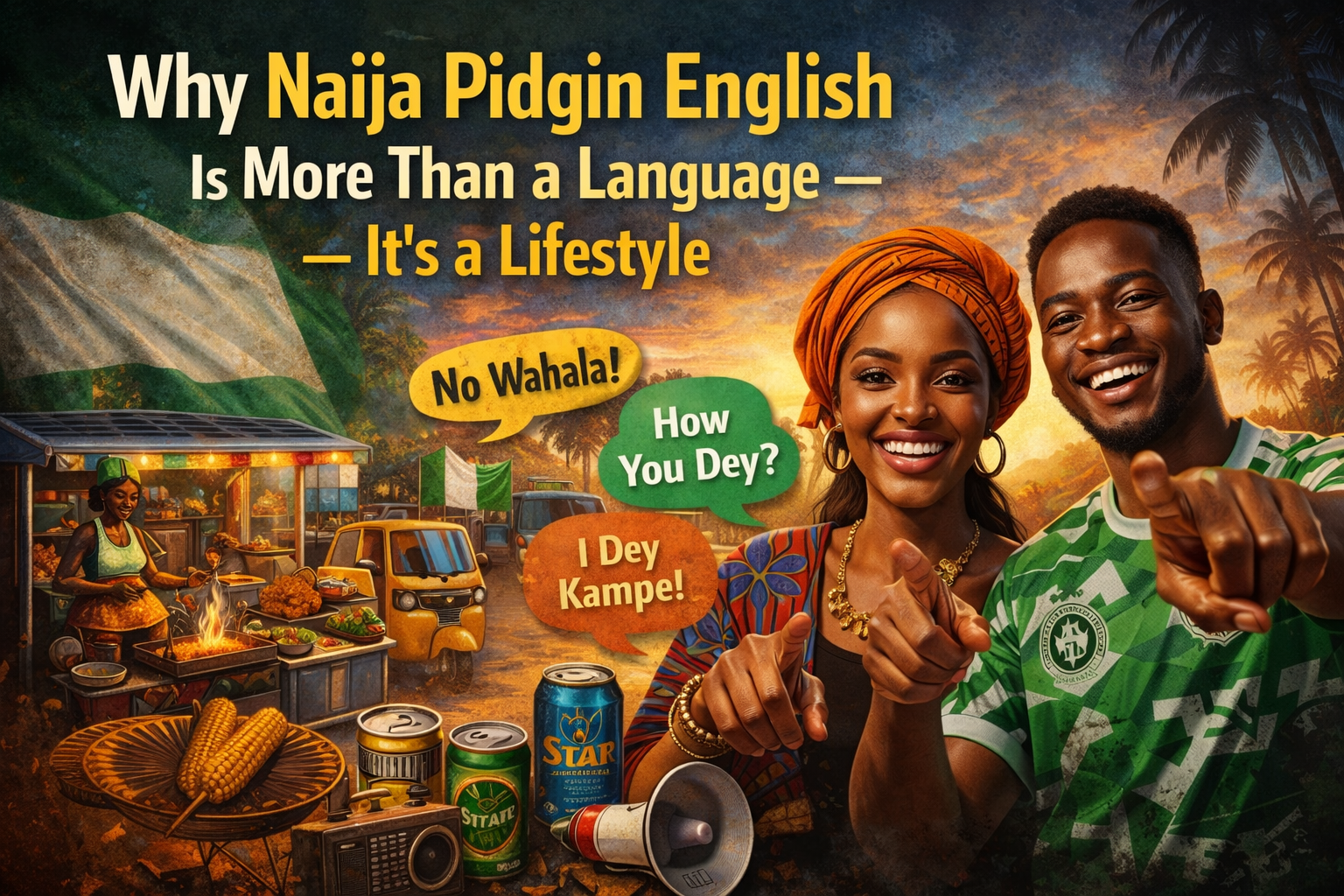
Why Naija Pidgin English Is More Than a Language — It’s a Lifestyle
If you’ve ever heard a Nigerian say “Abeg no wahala” or “Na so e be”, you already understand something powerful: Naija Pidgin English isn’t just a way of speaking—it’s a way of living.
Often dismissed as “broken English,” Naija Pidgin is, in reality, one of the most expressive, unifying, and culturally rich forms of communication in Africa. It carries humor, survival, resistance, and creativity in ways formal language often can’t.
To understand Naija Pidgin English is to understand Nigeria itself.
Naija Pidgin English: Born From Survival, Not Grammar
Naija Pidgin didn’t start in classrooms or grammar books. It emerged from necessity.
During colonial trade and early contact between Europeans and local communities, people needed a shared language to communicate across ethnic and linguistic lines. English blended with local languages—Yoruba, Igbo, Hausa, Edo, Ijaw, and others—creating a flexible, adaptive form of speech.
What began as a tool for trade evolved into a linguistic bridge across one of the most diverse countries in the world.
Nigeria has over 500 indigenous languages. Naija Pidgin became the common ground.
More Than Communication: Naija Pidgin as Identity
Language shapes identity, and Naija Pidgin English reflects a collective Nigerian mindset:
- Resilient in the face of hardship
- Humorous even in crisis
- Creative under pressure
- Honest, direct, and emotionally rich
Pidgin allows Nigerians to express frustration, joy, sarcasm, hope, and rebellion—often in a single sentence.
For example:
“We go survive.”
That phrase is not just reassurance. It’s a philosophy.
Why Naija Pidgin Feels More “Real” Than Formal English
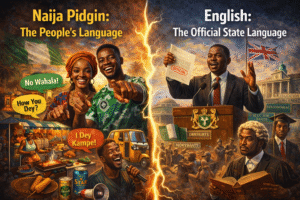
Formal English in Nigeria often signals authority—schools, government, corporate offices. But Naija Pidgin belongs to the people.
It’s the language of:
- The street vendor and the tech bro
- The bus conductor and the university professor
- The market woman and the pop star
When Nigerians switch to Pidgin, barriers drop. Status fades. Conversations become human.
That’s why politicians often campaign in Pidgin.
That’s why comedians rely on it.
That’s why musicians thrive in it.
Naija Pidgin in Music, Media, and Pop Culture
Modern Nigerian pop culture would be unrecognizable without Naija Pidgin English.
Music
Afrobeats artists like Burna Boy, Olamide, Wizkid, and Portable use Pidgin to:
- Speak directly to everyday realities
- Maintain authenticity
- Connect globally while staying local
Pidgin travels better than formal English because it carries emotion, rhythm, and attitude.
Comedy
Nigerian comedy thrives on Pidgin’s flexibility. Timing, exaggeration, sarcasm, and irony land harder in Pidgin than in polished English.
Media
Radio stations, online skits, podcasts, and even international broadcasters increasingly use Naija Pidgin to reach wider audiences.
BBC Pidgin is proof that the language has crossed from “street” to global relevance.
The Irony: “Broken English” That Unites Millions
One of the great ironies is that Naija Pidgin is often called “broken English,” yet it does something standard English fails to do:
It unites people.
Pidgin ignores strict grammar rules but follows social logic. It evolves quickly, absorbs slang, adapts tone, and reflects current realities.
It is not broken.
It is alive.
Naija Pidgin as Resistance and Power
Historically, colonized societies were taught that their languages were inferior. Speaking “good English” became associated with intelligence and success.
Pidgin challenged that idea.
Speaking Naija Pidgin is often an act of:
- Cultural pride
- Class resistance
- Authentic self-expression
It says: “I don’t need to sound like you to be intelligent.”
In this way, Naija Pidgin English is political—even when it’s playful.
Is Naija Pidgin a Language or a Lifestyle?
Here’s where the debate gets interesting.
A language is something you speak.
A lifestyle is something you live.
Naija Pidgin:
- Shapes humor
- Influences fashion slogans
- Defines social interactions
- Sets the tone for protest, love, and sarcasm
It’s why Nigerians abroad instantly connect through it.
It’s why a single Pidgin phrase can carry more meaning than a paragraph in formal English.
Naija Pidgin doesn’t just describe life—it interprets it.
Should Naija Pidgin Be Formalized?
There’s an ongoing debate:
Should Naija Pidgin be standardized and taught formally?
Arguments For:
- It validates cultural identity
- Improves literacy by teaching people in a familiar language
- Preserves linguistic heritage
Arguments Against:
- Formalization may strip its flexibility
- Grammar rules could weaken creativity
- Its power lies in informality
Perhaps Naija Pidgin’s strength is that it resists control.
Global Recognition, Local Ownership
As global interest in African culture grows, Naija Pidgin is increasingly heard worldwide. But with recognition comes risk—misinterpretation, dilution, or commercialization without respect.
The challenge ahead is ensuring Naija Pidgin remains owned by its speakers, not reduced to a trend.
Conclusion: “Na So E Be”
Naija Pidgin English is not a mistake.
It’s not laziness.
It’s not ignorance.
It is history, humor, pain, joy, survival, and style—compressed into a living language that refuses to be boxed.
To speak Naija Pidgin is to say:
- I belong
- I understand
- I adapt
- I endure
So yes, Naija Pidgin is more than a language.
Na lifestyle.
Language in contemporary African cultures and societies