


Introduction: When Intelligence Becomes Diplomacy
A two-hour meeting between the CIA Director and Venezuela’s new interim president would have been unthinkable just months ago. Yet this is the new reality unfolding in Caracas.
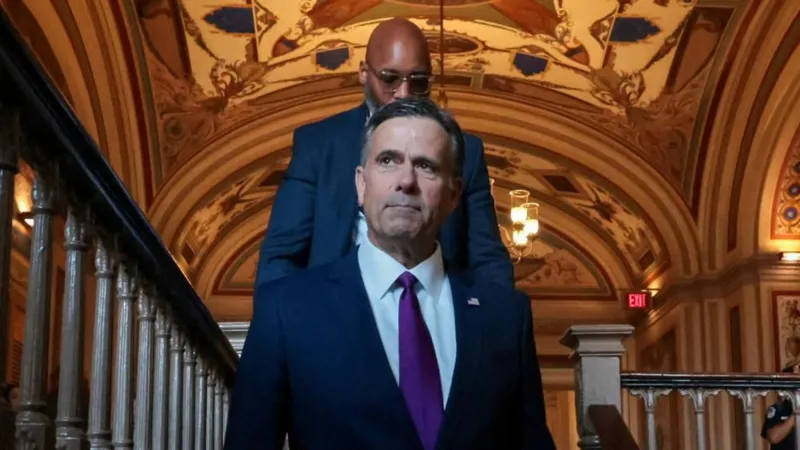
CIA Director John Ratcliffe’s meeting with Interim President Delcy Rodríguez, carried out “at President Trump’s direction,” marks a profound turning point in US–Venezuela relations, blending intelligence operations, regime change, economic ambition, and geopolitical recalibration into a single moment.
This was not merely a diplomatic courtesy call. It was a signal event — one that raises uncomfortable but necessary questions:
- Has intelligence replaced diplomacy as America’s primary foreign policy tool?
- Is Venezuela entering a new era of sovereignty — or a new form of dependency?
- And is oil, once again, the silent driver behind global power shifts?
This analysis goes beyond the headlines to examine what the CIA Venezuela meeting really means, who gains, who loses, and why the implications stretch far beyond Caracas.
The Context: Maduro’s Seizure and a Sudden Power Vacuum
Just weeks before Ratcliffe’s visit, US forces seized former President Nicolás Maduro and his wife, Cilia Flores, in a dramatic operation in Caracas. Both are now detained in New York on drug trafficking and related charges — allegations long denied by Maduro’s camp.
According to reporting by the BBC, the operation effectively decapitated Venezuela’s long-standing leadership, opening the door for Delcy Rodríguez, formerly vice president, to be sworn in as interim president on 5 January.
This was not a traditional internal transition. It was an externally catalyzed rupture — one that instantly reframed Venezuela’s political legitimacy, governance structure, and international posture (BBC – Venezuela crisis).
The CIA director’s presence in Caracas so soon after Maduro’s removal underscores how security, intelligence, and governance are now deeply entangled in Venezuela’s future.
Why the CIA — and Not the State Department?
One of the most striking elements of this development is who represented the United States.
Ratcliffe is not a diplomat. He is the head of America’s intelligence apparatus.
This choice matters.
Historically, CIA directors operate in shadows, not presidential palaces. Their visibility signals extraordinary strategic stakes. As noted by the Council on Foreign Relations, intelligence-led engagement often appears when Washington perceives both high risk and high opportunity (CFR – US intelligence and foreign policy).
The US official who described the meeting as “historic” also confirmed it aimed at building trust and communication, a phrase that in intelligence language often implies:
- Establishing red lines
- Managing transition risks
- Securing strategic assets
- Preventing hostile alignment with rival powers
In short, this was not about friendship. It was about control, predictability, and leverage.
Oil at the Center: Venezuela’s Real Strategic Value
Venezuela holds the largest proven oil reserves in the world, surpassing even Saudi Arabia. Yet years of sanctions, mismanagement, and political isolation rendered much of that wealth inaccessible.
Rodríguez’s first state-of-the-union address made one thing unmistakably clear: oil reform is the new government’s priority.
She announced sweeping changes to Venezuela’s hydrocarbon law, moving away from the long-standing requirement that foreign firms partner with PDVSA as a majority shareholder. This opens the door for direct foreign investment, particularly from US oil companies (US Energy Information Administration).
President Trump has been blunt. US firms, he said, will invest, extract, and sell Venezuelan oil — with Washington deciding who is allowed to operate.
“You’re dealing with us directly,” Trump stated. “You’re not dealing with Venezuela at all.”
That sentence alone has ignited debate about economic sovereignty versus economic rescue.
Economic Promise or Managed Dependency?
Rodríguez attempted to balance realism with nationalism. She spoke of defending Venezuela’s “dignity and honour” while acknowledging the necessity of foreign capital.
Her proposal to create two sovereign funds — one for social protection and one for infrastructure — is designed to reassure Venezuelans that oil revenue will not vanish into corruption or foreign hands.
But critics argue that when oil sales are controlled externally, sovereignty becomes symbolic rather than substantive.
According to analysis from Brookings, countries emerging from sanctions and regime collapse often face a “reform trap” — where economic opening becomes structurally irreversible and politically constrained (Brookings – resource politics).
Is Venezuela opening its economy — or surrendering it?
The US Strategic Lens: Adversaries and Access
The US official accompanying Ratcliffe stated clearly that Venezuela can no longer be a safe haven for America’s adversaries.
This is a reference to Russia, China, Iran, and non-state actors who expanded influence in Venezuela during years of US disengagement.
China financed infrastructure. Russia provided security support. Iran assisted with fuel and logistics.
From Washington’s perspective, Venezuela is not just about oil — it is about rolling back rival influence in the Western Hemisphere, a priority echoed in recent Pentagon strategy documents (US Department of Defense – Hemisphere strategy).
The CIA meeting was therefore as much about geopolitical alignment as economic reform.
Latin America Reacts: Precedent and Fear
Across Latin America, reactions have been cautious — even uneasy.
While some governments quietly welcome Maduro’s removal, others worry about the precedent: Can the US seize a sitting president and then negotiate terms with the successor?
This concern is amplified by Trump’s language of control rather than partnership.
As noted by Al Jazeera, Latin American history is marked by US interventions framed as stability measures but experienced locally as domination (Al Jazeera – US influence Latin America).
Rodríguez’s insistence on national unity and her declaration that she would walk to Washington “on her feet, not dragged there” reflects this deep historical memory.
Chevron, Corporations, and Conditional Capital
Chevron remains the last major US oil firm operating in Venezuela, but executives openly describe the country as “currently uninvestable.”
Infrastructure decay, legal uncertainty, and political risk remain severe.
Trump’s demand that oil firms commit at least $100 billion in investment highlights the scale of ambition — and the scale of required transformation.
Yet executives also know that investment under political control is not free-market capitalism; it is state-managed extraction under geopolitical supervision.
This blurring of corporate, state, and intelligence interests is not new — but it is becoming more explicit.
Ethical and Legal Questions
The CIA Venezuela meeting raises fundamental ethical questions:
- Can sovereignty exist under external economic supervision?
- Does regime change justify intelligence-led governance?
- Where is the line between assistance and coercion?
International law traditionally separates intelligence operations from diplomatic legitimacy. When that boundary dissolves, global norms weaken.
As Human Rights Watch has noted in previous transitions, economic recovery without political autonomy often breeds long-term instability (Human Rights Watch – governance transitions).
Public Sentiment Inside Venezuela
Amid elite negotiations and geopolitical maneuvering, ordinary Venezuelans face harsh realities.
Inflation, food scarcity, and collapsing purchasing power remain immediate concerns. Before Maduro’s seizure, many told the BBC they were worried less about politics and more about survival.
Rodríguez’s challenge is not convincing Washington — it is convincing Venezuelans that this new chapter will materially improve daily life, not simply change who controls the oil contracts.
Conclusion: A New Model of Power Projection?
The CIA director’s two-hour meeting in Caracas may prove to be a defining moment in modern US foreign policy.
It represents a model where:
- Intelligence leads diplomacy
- Economic leverage replaces military occupation
- Regime change is followed by managed reintegration
Whether this approach stabilizes Venezuela or entrenches dependency will depend on outcomes, not intentions.
What is certain is this: Venezuela is no longer isolated — but it is not fully free either.
The world is watching to see whether this experiment produces recovery, resentment, or resistance.
And readers are left with a pressing question:
Is this the future of global power — or a warning from history repeating itself in a new form?