












Introduction: When a Nation Writes Its Final Goodbye
The Denmark postal service end is not merely an administrative decision or a logistical adjustment—it is a cultural rupture. After more than 400 years, Denmark’s national postal service, PostNord, has ceased letter delivery, leaving parcels as the sole physical remnants of an institution once central to personal, civic, and national life.
Yet as infrastructure fades, meaning does not disappear quietly. Instead, it resurfaces—unexpectedly—in art.
British artist Gillian Taylor has chosen to mark this historical moment not through protest or nostalgia alone, but through participatory memory-making. By collecting the final letters ever sent through Denmark’s postal system and transforming them into an art installation, she raises a profound question:
What do we lose when communication becomes instant—but no longer tangible?
This article does not mourn the postal service as obsolete technology. Rather, it examines what its disappearance tells us about digital modernity, collective memory, slowness, and the human need to be witnessed.

Background Context: The Quiet End of a 400-Year Institution
Why Denmark Stopped Delivering Letters
PostNord announced that it would discontinue letter delivery following a 25-year decline in postal mail volume, a trend mirrored across highly digitised societies.
According to the Universal Postal Union, global letter volumes have fallen sharply as email, messaging apps, and digital platforms dominate communication
https://www.upu.int/
Denmark, often ranked among the world’s most digitally advanced nations, represents the endpoint of this transformation. Government correspondence, banking, healthcare, and even voting-related communications are now largely digital, supported by Denmark’s mandatory digital mailbox system
https://digst.dk/
Efficiency vs Cultural Continuity
From a policy standpoint, the decision is rational:
- Letters are expensive to deliver
- Demand is minimal
- Digital systems are faster and cheaper
But culture rarely conforms to efficiency models.
As sociologists have long argued, institutions carry symbolic weight beyond their function. The postal service was not just a delivery system—it was a ritual of waiting, anticipation, and permanence.
Letters as Cultural Artifacts, Not Data
What Makes Letters Different from Digital Messages
Unlike emails or texts, letters:
- Require intentional effort
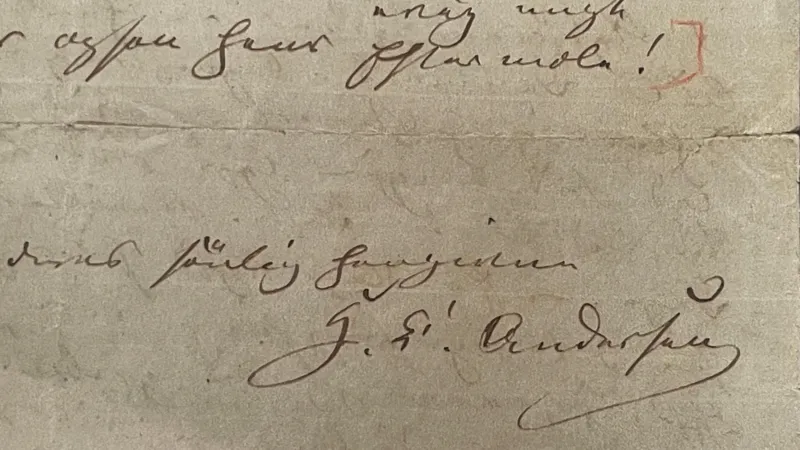
- Carry physical traces (handwriting, paper choice, stamps)
- Exist independently of platforms and servers
Cultural historians at the British Library note that handwritten correspondence offers insights into emotion, class, literacy, and social norms that digital communication often erases
https://www.bl.uk/
Letters slow time. They create pauses. They demand reflection.
This is precisely what makes their disappearance culturally significant.
Art as an Archive of Loss: Gillian Taylor’s Intervention
Med Venlig Hilsen — With Kind Regards
Taylor’s project, Med Venlig Hilsen, transforms final letters into suspended daisy forms—the national flower of Denmark—creating an installation that is both elegy and archive.
Art here performs a critical social function:
- It preserves what systems discard
- It turns private memory into collective witness
- It resists forgetting without resisting change
The use of daisies is not decorative. National symbols anchor personal stories within collective identity, reminding viewers that technological transitions are never emotionally neutral.
The Power of Participatory Memory
Why People Chose to Write One Last Time
Many contributors admitted they had not written a letter in decades. Yet when invited to do so for the last time, they rediscovered something deeply human.
One contributor described childhood memories of letters read aloud by her mother. Another sent maps marking the final remaining post boxes in her region.
This aligns with research in memory studies, which shows that endings often trigger reflection more powerfully than beginnings
https://journals.sagepub.com/
Letters become meaningful precisely because they are no longer routine.
From Andersen to Dickens: Literary Continuity Across Centuries
Taylor’s inclusion of letters exchanged between Hans Christian Andersen and Charles Dickens, courtesy of the Royal Danish Library, situates the project within a broader historical arc
https://www.kb.dk/
These letters remind us that:
- Cultural exchange once depended on physical correspondence
- Literature itself was shaped by postal networks
- Intellectual communities were built slowly, across borders
To end letter delivery is not to erase this past—but it does sever a living continuity with it.
The Digital Society Paradox: More Connected, Less Tangible
Denmark as a Case Study in Hyper-Digitalisation
Denmark consistently ranks among the top countries for digital governance and online public services
https://www.oecd.org/
Yet digital success brings paradoxes:
- Increased efficiency
- Reduced friction
- Loss of material culture
Anthropologists warn that fully digital societies risk flattening emotional expression, as communication becomes optimized rather than embodied.
What Children Will Never Experience
PostNord itself acknowledged that Taylor’s exhibition would be “important for children who did not grow up with letters.”
This raises a deeper concern:
- How will future generations understand patience?
- What replaces anticipation in a world of instant replies?
- Can digital artifacts carry emotional weight across decades?
Digital messages rarely survive platform collapse, software updates, or account deletion. Letters, by contrast, survive wars, migrations, and centuries.
The UNESCO Memory of the World Programme emphasizes the fragility of digital heritage without intentional preservation
https://www.unesco.org/
Is This Progress—or Cultural Amputation?
This is not a call to reverse digitalisation. Rather, it is a call to acknowledge what is lost alongside what is gained.
Progress narratives often assume replacement:
- Email replaces letters
- Messaging replaces postcards
But replacement is rarely symmetrical.
The end of postal letters removes:
- A sensory experience
- A temporal rhythm
- A physical archive of everyday life
Art as Resistance to Forgetting
Taylor’s installation does not argue that letters should return. Instead, it insists that their disappearance should be noticed.
Art becomes:
- A counterbalance to speed
- A site of reflection
- A bridge between past and future
As philosopher Walter Benjamin argued, modernity accelerates forgetting unless deliberate acts of remembrance intervene.
Global Implications: Denmark Is Not Alone
Many countries are watching Denmark closely. Postal services in:
- The UK
- Germany
- Japan
are all reducing letter delivery frequency
https://www.bbc.com/
Denmark may simply be the first to reach the endpoint.
The question is not whether letters will disappear elsewhere—but how societies choose to mark their passing.
Conclusion: When the Last Letter Is Read
The Denmark postal service end marks more than the closure of mail routes. It signals the conclusion of a way of relating to time, distance, and one another.
Through Gillian Taylor’s work, letters are allowed one final function—not to communicate information, but to testify.
They testify that:
- Slowness once mattered
- Waiting carried meaning
- Human connection left physical traces
In a world increasingly defined by speed and efficiency, perhaps the most radical act is not to resist change—but to remember what change leaves behind.