











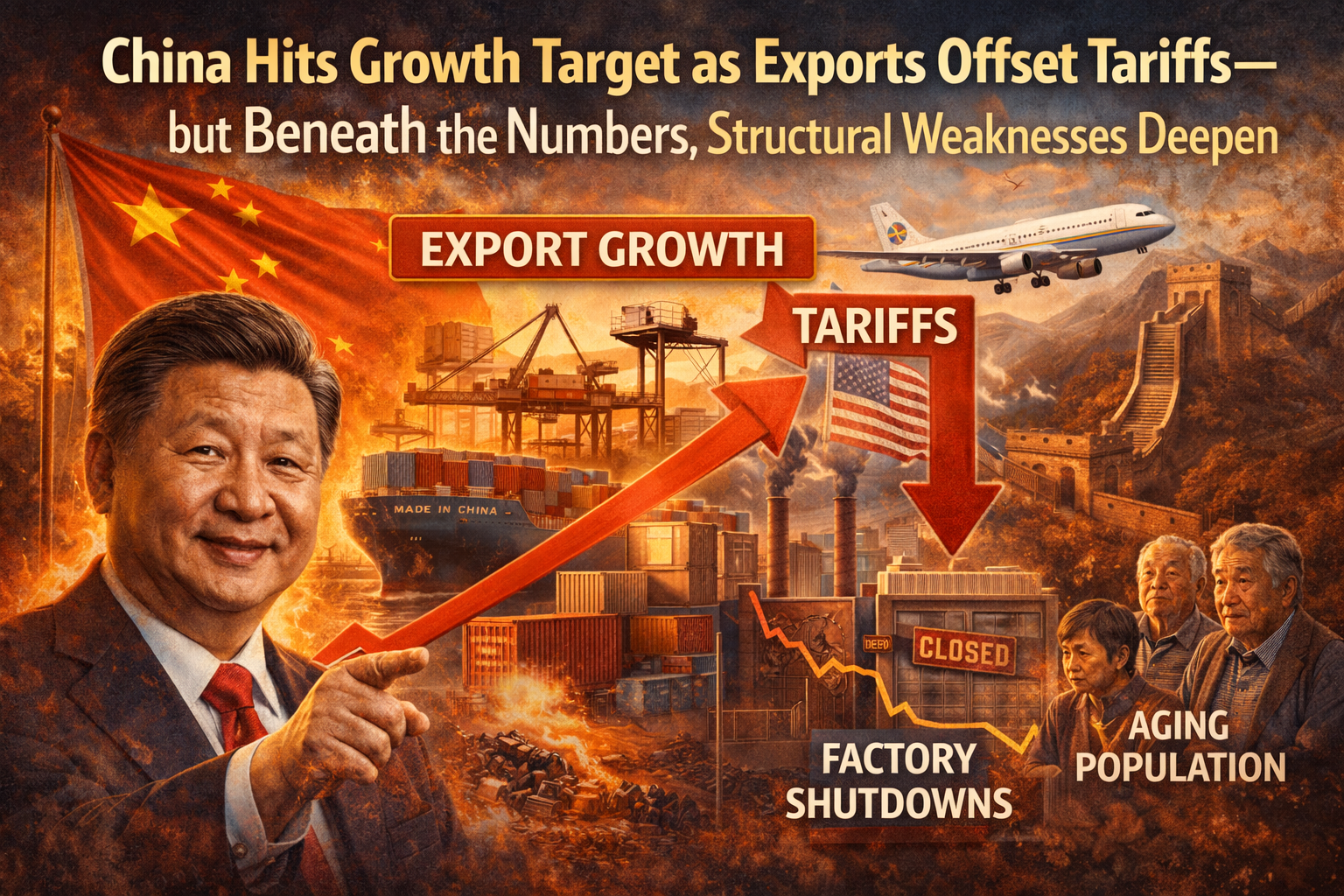
Introduction: A Target Met, but at What Cost?
China’s announcement that its economy grew by 5% in 2025, exactly meeting Beijing’s official target, was presented as a reassurance of resilience in the face of mounting domestic and external pressures. A record $1.19 trillion trade surplus, powered by surging exports, allowed the world’s second-largest economy to defy expectations—at least on paper.
Yet behind the headline figure lies a far more complex and fragile reality.
Growth slowed sharply to 4.5% in the final quarter, domestic demand remains weak, the property sector continues to contract, and China’s demographic decline is accelerating. Economists increasingly describe the country as operating a “two-speed economy”—one driven by factories and foreign markets, the other weighed down by cautious consumers, falling house prices, and structural uncertainty.
This article examines how China met its growth goal, why many economists doubt the official data, and what the underlying trends mean for the sustainability of China’s economic model.

The Export Engine: How Trade Propped Up Growth
A Record Trade Surplus
China’s 2025 growth was underwritten by the largest trade surplus in world history, as exports surged to markets beyond the United States.
According to trade economists, exporters compensated for tariff pressure by:
- Cutting prices aggressively
- Expanding sales in emerging markets
- Leveraging scale advantages in manufacturing
The World Trade Organization (WTO) has noted China’s continued dominance in global manufacturing supply chains despite geopolitical tensions
https://www.wto.org/
Defying US Tariffs—For Now
Although US President Donald Trump’s tariff policies created volatility, Beijing benefited from:
- A temporary pause in additional US tariffs
- Diversification away from the US market
- Strong demand for Chinese electric vehicles, machinery, and green technology
However, analysts warn this strategy relies heavily on thin margins and price competition, which undermines profitability over time.
As Natixis economist Alicia Garcia-Herrero put it:
“China is effectively pushing growth through exports at a loss—and that is not sustainable.”
A Two-Speed Economy Takes Shape
Manufacturing vs Domestic Demand
China’s economic performance now shows a clear split:
- Factory output: Up 5.2% in December
- Retail sales: Up just 0.9%, the slowest in three years
This divergence highlights the imbalance between production and consumption—an issue Chinese policymakers have struggled with for over a decade.
The OECD has repeatedly warned that overreliance on exports leaves economies vulnerable to external shocks
https://www.oecd.org/
Questioning the Numbers: Are Official Figures Overstated?
Scepticism Among Economists
While China’s National Bureau of Statistics reports a clean 5% expansion, many analysts remain unconvinced.
Capital Economics estimates that:
- True growth may be 1.5 percentage points lower
- Weak investment and consumption are inconsistent with reported GDP
Independent indicators—such as electricity consumption, freight volumes, and private-sector investment—paint a more subdued picture.
The Financial Times has documented longstanding concerns about the reliability of Chinese growth data
https://www.ft.com/
The Property Crisis: China’s Biggest Domestic Drag
Housing Market Still in Decline
New data confirms that China’s property sector remains under severe strain:
- House prices fell 2.7% year-on-year in December
- Property investment dropped 17.2% in 2025
This is not a marginal issue. Real estate once accounted for nearly 25% of China’s economy, directly and indirectly.
The International Monetary Fund (IMF) has warned that prolonged property weakness poses systemic risks to financial stability
https://www.imf.org/
Erosion of Household Wealth
Millions of Chinese households now face:
- Unfinished housing projects
- Properties worth less than their mortgages
- Lost confidence in real estate as a savings vehicle
This has had a chilling effect on consumption, reinforcing a cycle of caution and under-spending.
Demographics: A Shrinking Population Meets a Slowing Economy
Births at a Historic Low
China recorded just 7.9 million births in 2025, the lowest figure since records began in 1949. The population fell by 3.4 million, marking the fourth consecutive year of decline.
Despite incentives—cash bonuses, tax breaks, extended maternity leave—fertility remains around one child per woman, far below replacement level.
The United Nations Population Division projects China’s population could halve by 2100
https://www.un.org/development/desa/pd/
Economic Consequences of Demographic Decline
Falling birth rates will:
- Reduce future housing demand
- Weaken long-term consumption
- Shrink the workforce
- Increase pension and healthcare burdens
The World Bank warns that demographic decline could shave significant points off China’s long-term growth trajectory
https://www.worldbank.org/
Policy Dilemma: Stimulus vs Debt
Why Beijing Is Holding Back
Once the 5% target was secured, policymakers appeared reluctant to unleash large-scale stimulus, opting instead to conserve fiscal space.
China faces:
- Rising local government debt
- Weak confidence among private firms
- Limited effectiveness of traditional stimulus tools
According to the Bank for International Settlements (BIS), China’s debt-to-GDP ratio has risen sharply over the past decade
https://www.bis.org/
Trade Risks Ahead: A More Hostile Global Environment
Exposure to Tariff Escalation
China’s export-led resilience leaves it vulnerable to renewed trade conflict:
- The US tariff pause expires in November 2026
- Trump has threatened new levies tied to geopolitics
- Energy imports from Iran add diplomatic risk
The Peterson Institute for International Economics warns that escalating trade barriers could significantly hit China’s export volumes
https://www.piie.com/
Can China Rebalance Its Growth Model?
Structural Reform vs Short-Term Survival
Beijing has long pledged to:
- Boost domestic consumption
- Strengthen social safety nets
- Reduce reliance on property and exports
Yet progress has been limited, and political caution has slowed reform momentum.
The Asian Development Bank notes that rebalancing requires deeper reforms to income distribution, pensions, and household security
https://www.adb.org/
Conclusion: A Fragile Victory
China’s ability to hit its 5% growth target in 2025 is not insignificant—especially amid tariffs, property turmoil, and demographic decline. But the achievement rests on increasingly fragile foundations.
Exports are doing the heavy lifting, while domestic demand, real estate, and demographics pull in the opposite direction. Growth secured through external markets and price competition offers diminishing returns—and rising risks.
As Beijing enters 2026, it faces a narrowing path:
- Stimulate too aggressively and debt risks surge
- Hold back and growth falters
- Rely on exports and geopolitical exposure deepens
The numbers may say “target achieved.” The underlying economy, however, tells a more uncertain story.