





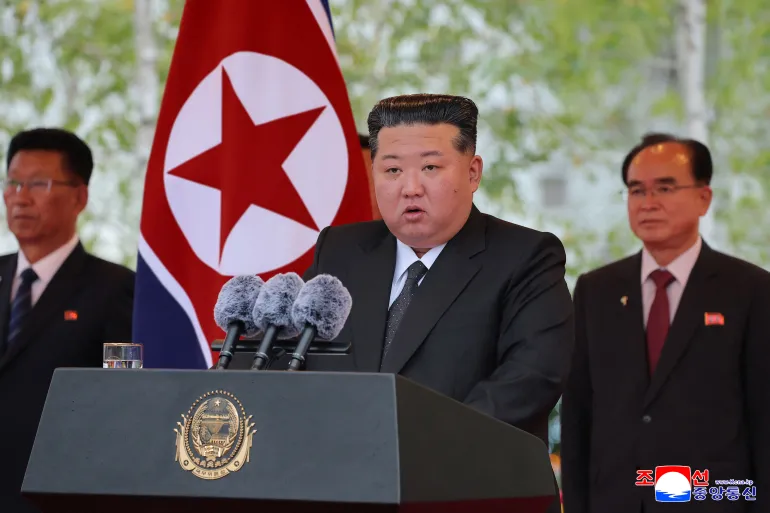
North Korean leader Kim Jong Un has dismissed a senior economic official and openly condemned party cadres for incompetence, an unusually public act of censure in one of the world’s most secretive political systems. The move signals heightened internal pressure as Pyongyang prepares for a pivotal ruling party meeting expected to shape the country’s economic and political trajectory.
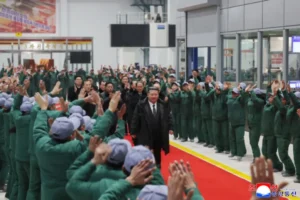
According to the state-run Korean Central News Agency (KCNA), Kim fired Vice Premier Yang Sung-ho during an on-site inspection marking the first-stage completion of a modernisation project at the Ryongsong Machine Complex, a key industrial facility. Yang was removed “on the spot,” with Kim declaring him “unfit to be entrusted with heavy duties.”
A Rare Public Dismissal in North Korea’s Power Structure
Public sackings of senior officials are uncommon in North Korea, where leadership changes are typically opaque and announced only after the fact. Kim’s decision to rebuke Yang publicly—and in vivid language—represents a deliberate political signal rather than a routine personnel change.
KCNA quoted Kim as likening the appointment of Yang to “hitching a cart to a goat,” adding that “it is an ox that pulls a cart, not a goat.” Such blunt rhetoric is notable in official North Korean discourse, which usually relies on ideological abstractions rather than direct personal criticism.
Yang, a former machinery industry minister elevated to vice premier overseeing the machinery sector, is also an alternate member of the Workers’ Party’s Political Bureau, according to South Korea’s Yonhap News Agency. No successor has yet been announced, reinforcing the impression of an abrupt and punitive decision rather than a planned reshuffle.
(See: https://en.yna.co.kr)
Economic Underperformance and Industrial Delays
Kim’s rebuke extended beyond one individual. During his visit to the Ryongsong Machine Complex, he blamed “irresponsible, rude and incompetent economic guidance officials” for delays in the modernisation project.
The Ryongsong complex plays a strategic role in North Korea’s industrial base, supporting machinery production essential to infrastructure, manufacturing, and potentially defence-related supply chains. Persistent delays there point to broader structural challenges in North Korea’s economy, including outdated equipment, international sanctions, and limited access to advanced technology.
Kim warned that current policymakers could “hardly guide the work of readjusting the country’s industry as a whole and upgrading it technologically,” underscoring frustration with stalled economic reform and implementation.
(See background: https://www.brookings.edu | https://www.csis.org)
Political Timing: The Ninth Party Congress
The dismissal comes as the Workers’ Party of Korea prepares for its Ninth Party Congress, a major political event expected to outline new economic priorities, personnel alignments, and strategic goals.
Historically, party congresses serve as moments of consolidation for Kim’s authority, allowing him to reward loyalists, remove underperformers, and reset policy narratives. Analysts view the public firing as a disciplinary warning aimed at senior cadres ahead of the congress, reinforcing expectations of obedience and results.
South Korean analysts quoted by Yonhap described the move as a discipline-tightening measure, designed to pre-empt dissent or complacency during a sensitive political period.
Public Accountability as a Control Mechanism
Experts note that Kim Jong Un has increasingly used public accountability—rather than quiet purges alone—as a tool of governance. According to Yang Moo-jin of the University of North Korean Studies, Kim is employing such rebukes as a “shock tactic” to instil fear and compliance among party officials.
This approach mirrors earlier high-profile cases, most notably the 2013 purge and execution of Jang Song Thaek, Kim’s uncle, accused of treason and factionalism. While today’s political climate differs, the underlying message remains consistent: loyalty and performance are inseparable, and failure carries severe consequences.
(See: https://www.rand.org | https://www.38north.org)
Security Concerns and Elite Instability
The firing also follows reports that North Korea recently replaced top military officials responsible for Kim’s personal security, reportedly due to concerns over assassination threats. According to Yonhap, the leadership of three major security units—the Party Guard Office, the State Affairs Commission Guard Department, and the Bodyguard Command—were all changed.
Though unconfirmed by Pyongyang, the reports suggest heightened anxiety within the regime, where internal loyalty is as critical as external deterrence.
Together, the personnel shake-ups in both economic and security spheres point to elite instability, or at least to Kim’s determination to reassert direct control at multiple levels of governance.
(See: https://www.reuters.com | https://www.cfr.org)
Strategic Implications
Kim Jong Un’s public dismissal of Vice Premier Yang Sung-ho underscores several key dynamics shaping North Korea today:
- Economic pressure: Chronic inefficiencies and sanctions-related constraints are straining industrial projects central to Kim’s development agenda.
- Centralised authority: Kim continues to personalise accountability, reinforcing his role as the ultimate arbiter of competence.
- Pre-congress discipline: The move sends a clear warning ahead of the Ninth Party Congress, discouraging dissent and underperformance.
- Governance by fear and symbolism: Public humiliation functions as both punishment and deterrent in a system with limited institutional checks.
While rare, such episodes provide rare insight into the internal mechanics of a regime that typically operates behind closed doors.
Conclusion
The abrupt firing of a vice premier and the public condemnation of economic officials reveal a North Korean leadership grappling with stalled industrial progress and internal discipline ahead of a crucial political milestone. By making an example of Yang Sung-ho, Kim Jong Un has reinforced a familiar message: authority flows from performance, and failure—especially when visible—will not be tolerated.
As North Korea moves toward its Ninth Party Congress, the episode highlights both the regime’s economic frustrations and its reliance on coercive governance to maintain control.