







Russia–Ukraine War Day 1,426: Missile Strikes, Energy Warfare, and the Narrowing Path to Diplomacy
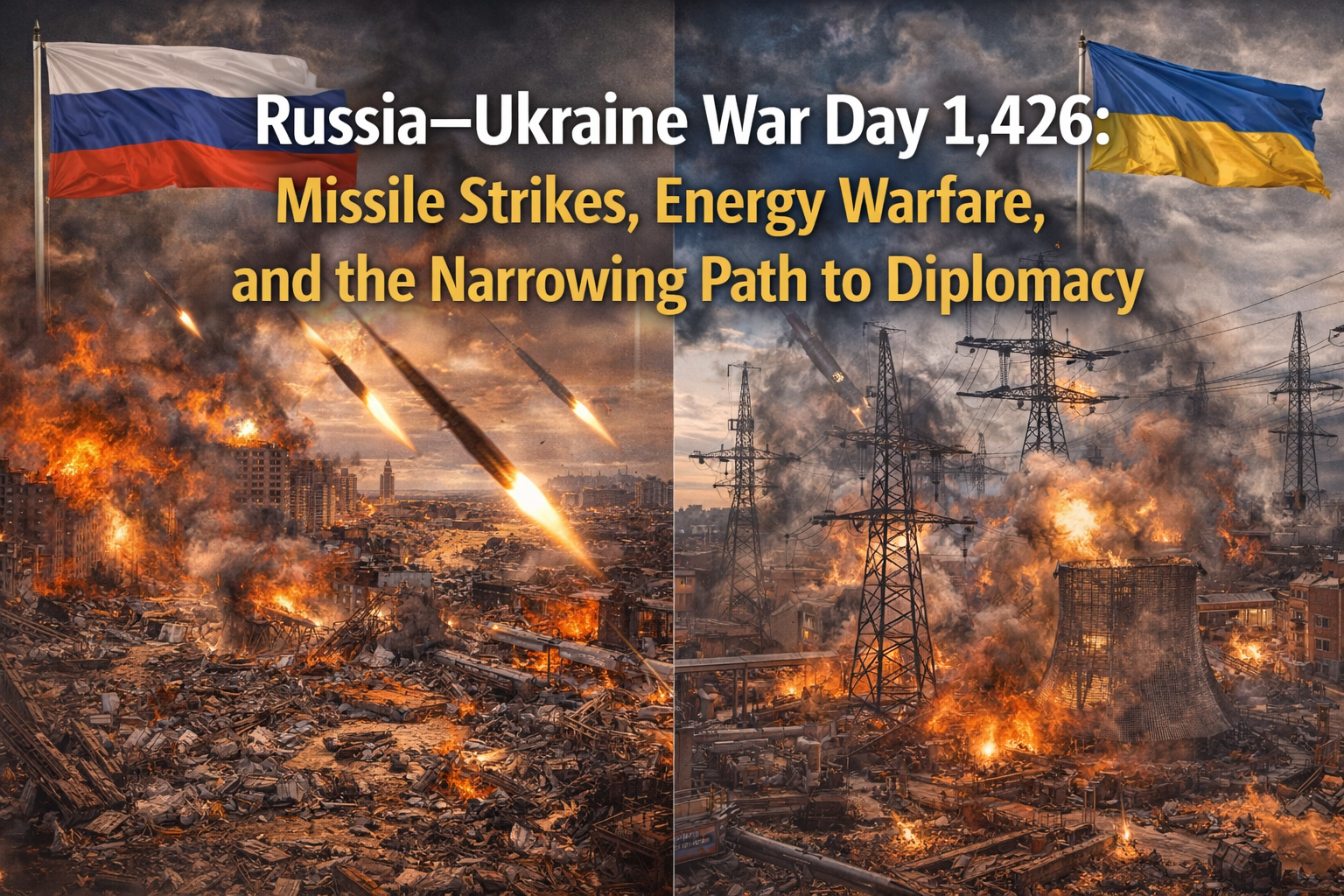
Russia-Ukraine war day 1,426 unfolded with intensified military pressure on Ukrainian cities, renewed attacks on energy infrastructure, and cautious diplomatic maneuvering on the margins of the World Economic Forum in Davos. As winter deepens across Eastern Europe, the conflict continues to evolve into a war of endurance—testing Ukraine’s resilience, Russia’s economic capacity, and the international community’s ability to prevent further escalation.
Intensified Fighting and Missile Threats Over Kyiv
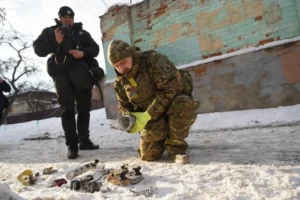
Early Tuesday morning, explosions were reported in Kyiv following warnings from Ukraine’s Air Force that Russia had launched ballistic missiles toward the capital. Air defence systems were activated as emergency alerts echoed across the city, underscoring the persistent vulnerability of even Ukraine’s most fortified urban centers.
According to Ukrainian military officials, Russia simultaneously launched a large-scale drone barrage, deploying 145 drones across multiple regions. Ukrainian forces reported intercepting 126, reflecting both the scale of the attack and the growing sophistication of Ukraine’s air defence network.
President Volodymyr Zelenskyy confirmed that Ukraine is deploying small, mobile interceptor drone units, a tactical shift designed to counter saturation attacks and reduce dependency on expensive missile systems. Analysts note that this adaptation mirrors broader trends in modern warfare, where low-cost unmanned systems increasingly shape battlefield outcomes.
Energy Infrastructure as a Strategic Target
Energy infrastructure once again emerged as a central battlefield. Russian strikes damaged electricity and gas facilities in five Ukrainian regions, leaving thousands without power amid freezing winter temperatures.
In the Odesa region, Ukraine’s largest private energy company, DTEK, reported that one of its facilities was “substantially damaged,” cutting electricity to more than 30,800 households. Regional authorities confirmed at least one civilian injury.
Odesa’s strategic importance—as a Black Sea port and energy hub—makes it a recurring target. Energy analysts warn that repeated strikes are aimed not only at immediate disruption but also at degrading Ukraine’s long-term recovery capacity.
(See: https://dtek.com)
Kharkiv and Southern Front Developments
Russia also struck Kharkiv, Ukraine’s second-largest city, with missiles that severely damaged a critical infrastructure facility. Mayor Ihor Terekhov confirmed the impact but withheld details, citing security concerns.
On the southern front, Russia’s Ministry of Defence claimed control of Pavlivka (Zaporizhzhia region) and Novopavlivka (Donetsk region). These claims could not be independently verified, a recurring challenge in a conflict where information warfare runs parallel to kinetic operations.
Military observers note that even limited territorial advances carry symbolic weight, particularly as Moscow seeks to project momentum ahead of diplomatic engagements.
Allegations of War Crimes and Accountability Challenges
The humanitarian dimension of the conflict deepened further with reports that Ukraine’s SBU security service detained a Russian soldier suspected of executing nine Ukrainian prisoners of war in 2024. The allegations, reported by The Kyiv Independent, add to mounting evidence compiled by international investigators.
Human rights organizations continue to stress that accountability mechanisms—while slow—remain critical to post-war reconciliation and international legal norms.
(See: https://www.icrc.org | https://www.ohchr.org)
Military Aid Constraints and Strategic Calculations
Not all developments favored Kyiv. The Czech Republic announced it would neither sell nor donate L-159 light combat aircraft to Ukraine, despite Kyiv’s proposal to purchase the jets for drone interception. Prime Minister Andrej Babiš rejected the plan, diverging from earlier remarks by President Petr Pavel.
This decision highlights the political and logistical limits of European military support, even among Ukraine’s strongest backers. Analysts suggest that while aid continues, donor fatigue and domestic pressures are increasingly shaping policy choices.
Energy Security, Nuclear Risks, and International Oversight
Energy security remains tightly linked to nuclear safety. The International Atomic Energy Agency (IAEA) confirmed that the 330-kilovolt Ferosplavna-1 power line supplying the Russian-controlled Zaporizhzhia nuclear power plant has been reconnected. The line is one of only two external power sources supporting the facility.
Ukraine’s Energy Minister warned the IAEA of Russian preparations for additional strikes on energy infrastructure, including systems essential for nuclear plant operations.
The IAEA has repeatedly cautioned that sustained power disruptions increase the risk of nuclear accidents, even without direct strikes on reactors.
(See: https://www.iaea.org)
Economic Pressures on Russia’s War Effort
Economic signals suggest growing strain on Russia’s capacity to sustain the war. According to a Reuters analysis, Russia’s federal budget revenue from oil and gas taxes is expected to fall 46 percent in January compared to the same period last year, driven by weaker oil prices and a stronger rouble.
Oil and gas revenues remain the backbone of Moscow’s war financing. A prolonged downturn could force difficult fiscal trade-offs, even as Russia accelerates arms production.
Meanwhile, Poland’s Gaz-System announced plans to increase gas transmission capacity to Ukraine between February and April, offering a partial buffer against continued attacks on Ukraine’s energy grid.
(See: https://www.gaz-system.pl)
Diplomacy at Davos: Limited Openings, Hard Realities
Diplomatic efforts continue, albeit cautiously. Ukraine confirmed it held “substantive” talks with US representatives, including Jared Kushner and envoy Steve Witkoff, focusing on security guarantees and post-war economic cooperation. Further discussions are expected at the World Economic Forum in Davos.
(See: https://www.weforum.org)
President Zelenskyy expressed hope that formal agreements on post-war security assurances could be signed with the United States.
Russia, meanwhile, is also engaging diplomatically. President Vladimir Putin’s envoy Kirill Dmitriev is expected to attend Davos and hold meetings with members of the US delegation, according to Reuters. The parallel presence of both sides underscores the forum’s role as a rare neutral venue—but expectations for breakthroughs remain low.
Elections, Governance, and War-Time Democracy
Ukraine’s election chief, Oleh Didenko, acknowledged the immense challenges of holding elections amid ongoing war, damaged infrastructure, and mass displacement—responding to calls from US political figures urging Kyiv to proceed with a vote.
The issue highlights a broader tension between democratic norms and wartime realities, one that Ukraine’s leadership argues cannot be resolved without security stabilization.
Conclusion: A War of Attrition With Global Consequences
By day 1,426, the Russia-Ukraine war has entrenched itself as a prolonged conflict shaped by energy warfare, drone saturation, economic pressure, and constrained diplomacy. While neither side appears close to decisive victory, the cumulative effects—on civilians, infrastructure, and global security—continue to mount.
As winter tightens its grip and international attention oscillates between crises, Ukraine’s ability to endure and adapt remains central to the conflict’s trajectory, while Russia faces growing economic and diplomatic constraints. The coming months may not deliver peace, but they will likely define the war’s next strategic phase.