








Spain’s Deadliest High-Speed Rail Disaster in Over a Decade: What the Adamuz Crash Reveals About Risk, Speed, and Rail Safety
Introduction: A Shock to Europe’s Rail Confidence
Spain has long been regarded as a global leader in high-speed rail infrastructure, boasting the second-largest network in the world after China. That reputation has been deeply shaken following a catastrophic collision near the town of Adamuz in southern Spain, where at least 39 people were killed and dozens more injured in the country’s worst rail disaster in more than ten years.
The collision, involving two high-speed passenger trains travelling in opposite directions, occurred on a straight section of track, a fact that has left investigators and railway experts “extremely baffled,” according to Spain’s transport minister. As rescue teams continue recovery efforts and authorities begin a complex investigation, the tragedy has reopened urgent debates about rail safety, system redundancy, private–public rail operations, and the risks inherent in ultra-high-speed transport.
This article examines what is currently known about the crash, situates it within Spain’s rail history, and explores broader implications for high-speed rail safety across Europe and beyond.
What Happened in Adamuz? Known Facts So Far
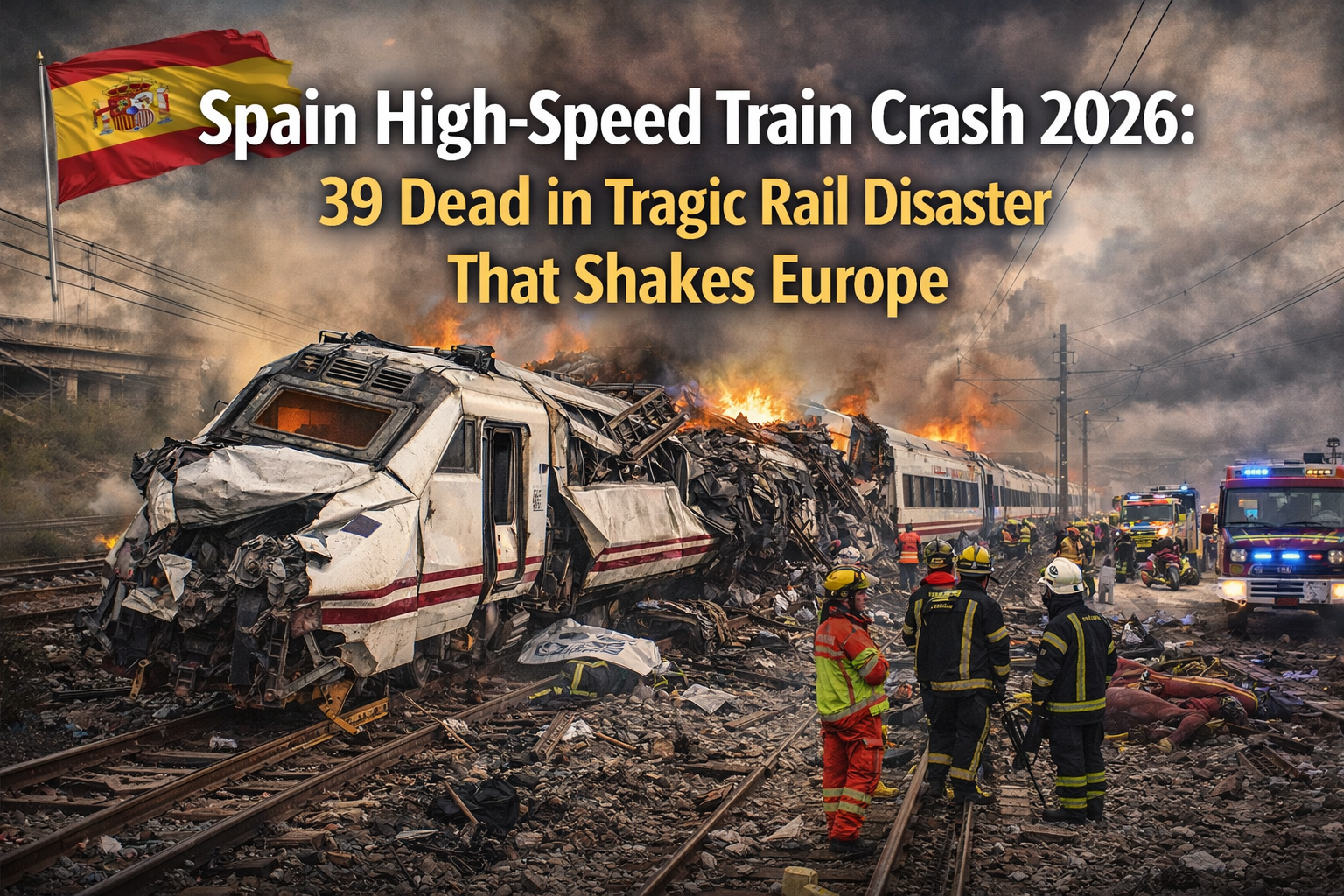
According to Spain’s Civil Guard and rail operator Adif, the accident occurred at 19:45 local time on Sunday evening, roughly an hour after a Madrid-bound train departed Málaga. The train derailed, crossed onto the opposite track, and collided head-on with an oncoming service travelling south from Madrid to Huelva.
Key confirmed details include:
- At least 39 fatalities, with the toll expected to rise
- 122 people treated by emergency services
- 48 hospitalised, including five children
- 12 patients in intensive care
- Around 400 passengers and staff across both trains
The force of the impact pushed several carriages into a nearby embankment. Most fatalities were concentrated in the front carriages of the second train, according to Transport Minister Óscar Puente.
“This is an extremely strange incident,” Puente said, noting that railway experts consulted by the government were unable to immediately explain how such a derailment could occur on a straight stretch of track.
The Trains Involved: Speed and Technology
One of the trains involved was identified as a Freccia 1000, manufactured by Hitachi Rail and operated by Italy’s Ferrovie dello Stato. These trains are capable of reaching top speeds of 400 km/h (250 mph), though operational speeds in Spain are typically lower.
The Freccia 1000 is widely used across Europe and is designed to meet stringent EU safety and interoperability standards, including:
- European Train Control System (ETCS)
- Automatic braking systems
- Continuous monitoring of track and speed conditions
More information on the Freccia 1000 platform can be found via Hitachi Rail:
https://www.hitachirail.com/products-and-solutions/high-speed/frecciarossa-1000/
That such a technologically advanced train derailed on a straight section of track raises serious questions about infrastructure integrity, signalling systems, or possible mechanical failure.
Emergency Response: Rescue Under Extreme Conditions
Emergency responders described chaotic and harrowing conditions at the crash site. Twisted metal, overturned carriages, and unstable structures complicated rescue operations.
Córdoba fire chief Francisco Carmona told Spain’s public broadcaster RTVE:
“We have even had to remove a dead person to be able to reach someone alive. It is hard, tricky work.”
Advanced medical posts were set up, and Adif established family support centres at major stations including Atocha, Seville, Córdoba, Málaga, and Huelva. The Spanish Red Cross deployed crisis counsellors to assist families facing prolonged uncertainty.



Eyewitness Accounts: ‘It Felt Like an Earthquake’
Passengers described the collision as sudden and violent. Salvador Jimenez, a journalist with RTVE who was onboard one of the trains, said:
“There was a moment when it felt like an earthquake and the train had indeed derailed.”
Footage from the scene shows carriages tipped onto their sides, with rescue workers climbing through windows and doors to evacuate survivors. Other passengers reported screaming, confusion, and desperate calls for medical help.
Spain’s Rail Safety Record: A Troubling Echo of 2013
This disaster inevitably recalls Spain’s worst rail accident in recent history: the 2013 Santiago de Compostela derailment in Galicia, which killed 80 people and injured more than 140. That crash was ultimately linked to excessive speed and inadequate automatic braking systems on a curved section of track.
Following the 2013 tragedy, Spain implemented several safety upgrades aligned with EU rail safety directives, including expanded use of ETCS and stricter driver training requirements.
Background on EU rail safety frameworks is available via the European Union Agency for Railways (ERA):
https://www.era.europa.eu
The Adamuz crash, however, differs in one critical respect: it occurred on a straight section of track, where derailments are statistically rare. This has intensified scrutiny of track integrity, switch systems, signalling errors, or external interference.
Public and Political Reaction
Spain’s Prime Minister Pedro Sánchez described the incident as a “night of deep pain” for the country. King Felipe VI and Queen Letizia issued a statement expressing “great concern” and condolences for the victims’ families.
International leaders, including French President Emmanuel Macron, Italian Prime Minister Giorgia Meloni, and European Commission President Ursula von der Leyen, also offered messages of solidarity, underscoring the incident’s significance for Europe’s integrated transport network.
Investigations and Accountability: What Comes Next
Spain’s transport ministry has launched a full investigation, though officials caution that determining the cause could take at least a month. Investigators are expected to examine:
- Track condition and maintenance records
- Signalling and control systems
- Train mechanical data recorders
- Communication logs between operators and control centres
- Potential human factors or procedural failures
The involvement of both a private operator (Iryo) and a state-funded operator (Renfe) may also raise questions about coordination and oversight in Spain’s increasingly liberalised rail market.
For context on rail accident investigation standards, see the International Transport Forum (OECD):
https://www.itf-oecd.org/rail-safety
Broader Implications: Is High-Speed Rail Inherently Risky?
High-speed rail remains statistically one of the safest modes of transport, particularly compared with road travel. According to the International Union of Railways (UIC), fatal accidents on high-speed networks are exceptionally rare relative to passenger kilometres travelled.
However, when failures do occur, the consequences are often catastrophic due to speed, passenger density, and kinetic force. The Adamuz crash highlights the importance of:
- Redundant safety systems
- Continuous infrastructure monitoring
- Transparent accident investigations
- Public trust in rail governance
As countries across Europe, Asia, and Africa invest heavily in high-speed rail as a low-carbon alternative to aviation, confidence in safety systems is critical.
Conclusion: A Tragedy That Demands Answers
The Adamuz train collision is not only a national tragedy for Spain but a sobering moment for the global rail industry. With dozens of lives lost and many more forever altered, the investigation’s findings will carry implications far beyond Andalusia.
Whether the cause lies in infrastructure failure, system malfunction, or human error, one conclusion is already clear: even the most advanced transport systems require constant vigilance, accountability, and investment.
As Spain mourns its dead, the rest of the world watches closely—waiting not just for answers, but for assurances that such a disaster will not be repeated.