



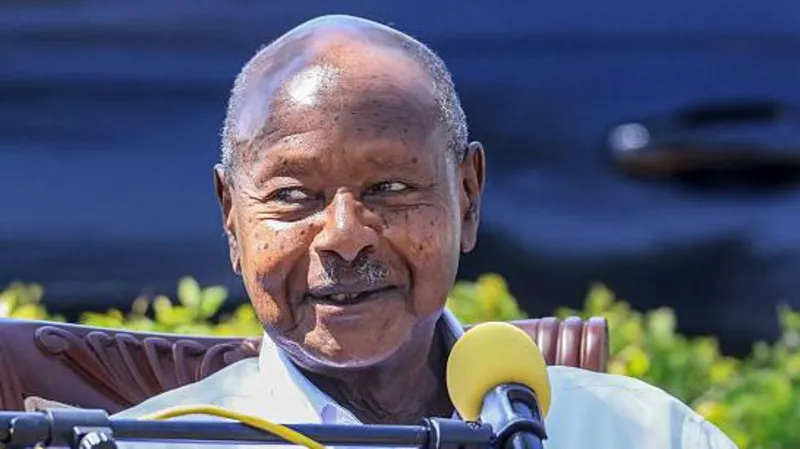
Uganda’s presidential election has once again descended into violence, fear, and political uncertainty — a familiar pattern in a country where elections have repeatedly reinforced power rather than transferred it.
As provisional results show President Yoweri Museveni taking a commanding lead, reports emerged overnight that at least seven opposition supporters were killed during clashes in Butambala district. Opposition figures accuse security forces of firing live bullets into crowds gathered at the home of an opposition MP. Authorities, in contrast, claim police acted in self-defence against armed opposition supporters.
This is not merely a dispute over numbers. It is a deeper crisis of credibility, legitimacy, and democratic survival in one of East Africa’s most strategically important nations.
The events unfolding in Uganda raise uncomfortable questions:
Is this election a democratic exercise — or a managed ritual of power renewal?
Can opposition politics survive under militarised governance?
And how long can stability be used to justify repression?
What Happened in Butambala: Two Versions, One Tragedy
The violence reportedly occurred at the home of Opposition MP Muwanga Kivumbi, where supporters had gathered to follow early election results.
According to Kivumbi, security forces fired tear gas and then live ammunition, killing multiple people inside his home. Human rights activist Agather Atuhaire corroborated this account, describing a chaotic and deadly security operation.
Police spokesperson Lydia Tumushabe, however, offered a sharply different narrative. She told Reuters that police were responding to an attack by what she called “NUP goons” who were allegedly armed with machetes and incendiary materials and planned to overrun a tallying centre.
Regardless of which version is closer to the truth, one fact is uncontested: Ugandan citizens died during an election process — a reality that fundamentally undermines the legitimacy of the vote.
This mirrors a broader regional pattern where security forces are routinely deployed as arbiters of political outcomes rather than neutral protectors of the electoral process (Human Rights Watch – Uganda).
Museveni’s Lead: Numbers That Tell Only Half the Story
Figures released by Uganda’s Electoral Commission place Museveni at 75% of the vote, with opposition leader Bobi Wine trailing at 21%, based on returns from 60% of polling stations.
On paper, this appears decisive. Politically, it is deeply contested.
Museveni, now 81 years old, is seeking a seventh term, extending a rule that began in 1986. Each election cycle has followed a similar trajectory: opposition enthusiasm, heavy security deployment, allegations of fraud, and eventual consolidation of power.
According to election analysts cited by the Africa Center for Strategic Studies, electoral dominance in long-ruling regimes often reflects control of institutions rather than popular consent (ACSS – Elections in Africa).
Bobi Wine Under Siege: House Arrest or “Protection”?
As results rolled in, security forces surrounded Bobi Wine’s home in Magere, effectively placing him under house arrest, according to his party, the National Unity Platform (NUP).
Wine’s party reported that security officers breached his compound and erected tents inside — a claim that evokes strong memories of the aftermath of the 2021 election, when Wine was similarly confined for days.
Police spokesperson Kituuma Rusoke insisted the deployment was for Wine’s “own security,” describing him as a “person of interest.”
The phrase is telling.
In authoritarian-leaning systems, opposition leaders are often framed simultaneously as protected individuals and potential threats, justifying indefinite surveillance and restriction. The result is political containment without formal charges — a grey zone that erodes civil liberties while maintaining a façade of legality (Amnesty International – Political repression).
The Internet Blackout: Silencing in the Digital Age
Uganda’s election took place under a nationwide internet shutdown, imposed days before voting. Authorities claimed the blackout was necessary to prevent misinformation and violence.
The UN Human Rights Office, however, condemned the move as “deeply worrying,” noting that internet shutdowns disproportionately harm transparency, accountability, and freedom of expression (UN OHCHR – Internet shutdowns).
The blackout has had immediate consequences:
- Delayed reporting of violence
- Limited independent verification of results
- Restricted communication between opposition leaders and supporters
In modern elections, information control is as powerful as physical force. By cutting digital access, the state effectively controls narrative flow — determining what the public sees, hears, and remembers.
A Campaign Marked by Intimidation
The election followed a campaign period marred by violence, arrests, and disrupted opposition rallies. Security forces have repeatedly been accused of assaulting and detaining Wine’s supporters.
Wine, a former pop star turned politician whose real name is Robert Kyagulanyi, has positioned himself as the voice of Uganda’s youth — a critical demographic in a country where the majority of citizens are under 30.
Museveni, by contrast, has campaigned as the indispensable guarantor of stability, arguing that his leadership prevents Uganda from sliding into chaos.
This framing — stability versus change — has become a defining narrative in many African states where long-serving leaders face youthful opposition movements (Brookings – Youth and African politics).
Delayed Voting and Technical Failures
Election day itself was plagued by logistical failures:
- Ballot boxes arrived hours late
- Biometric voter verification machines malfunctioned
- Polling stations opened up to four hours behind schedule
Some observers have linked these issues to the internet blackout, though electoral officials deny any connection.
Electoral Commission chair Simon Byabakama insisted that vote transmission was unaffected, stating that results were being sent through a “private system.”
For critics, such assurances ring hollow in a context where institutional independence is widely questioned.
International Warnings Ignored
Ahead of the vote, the UN Human Rights Office warned that the election would likely be marked by “widespread repression and intimidation.”
Those warnings now appear prescient.
Yet international responses remain cautious. Uganda’s strategic importance — including its role in regional security and peacekeeping missions — has historically muted external pressure.
This reflects a broader dilemma in global diplomacy: how far will the international community go in defending democratic norms when stability and security cooperation are at stake?
The Bigger Picture: Democracy or Dynasty?
Museveni’s continued dominance has fueled speculation that he is preparing his son, Muhoozi Kainerugaba, Uganda’s military chief, as a successor — a claim the president denies.
Whether or not formal succession plans exist, Uganda increasingly resembles a personalised state, where power flows through family, military, and patronage networks.
Such systems often survive elections not because they are popular, but because they are structurally insulated from defeat.
What Comes Next?
The Electoral Commission has said final results will be announced within 48 hours. Given historical precedent, a Museveni victory appears inevitable.
The real question is not who wins, but what follows:
- Will opposition supporters accept the outcome?
- Will security forces maintain restraint?
- Will Uganda’s youth continue to believe change is possible through the ballot box?
Wine has previously called for protests if results were manipulated, but as of now, no mass demonstrations have occurred — perhaps a sign of fear, fatigue, or calculation.
Conclusion: An Election That Deepens, Not Resolves, Uganda’s Crisis
The deaths of opposition supporters during Uganda’s election are not isolated incidents. They are symptoms of a deeper malaise — one where elections function less as instruments of choice and more as rituals of power confirmation.
Museveni may extend his four-decade rule, but legitimacy cannot be indefinitely sustained by force, information control, and institutional dominance.
For Uganda, the tragedy is not just who governs — but whether democratic hope itself is slowly being extinguished.
For the international community, the question remains: how many such elections will be accepted before democracy becomes an empty word?