







Ukraine Peace Talks and the Return of the Most Difficult Questions
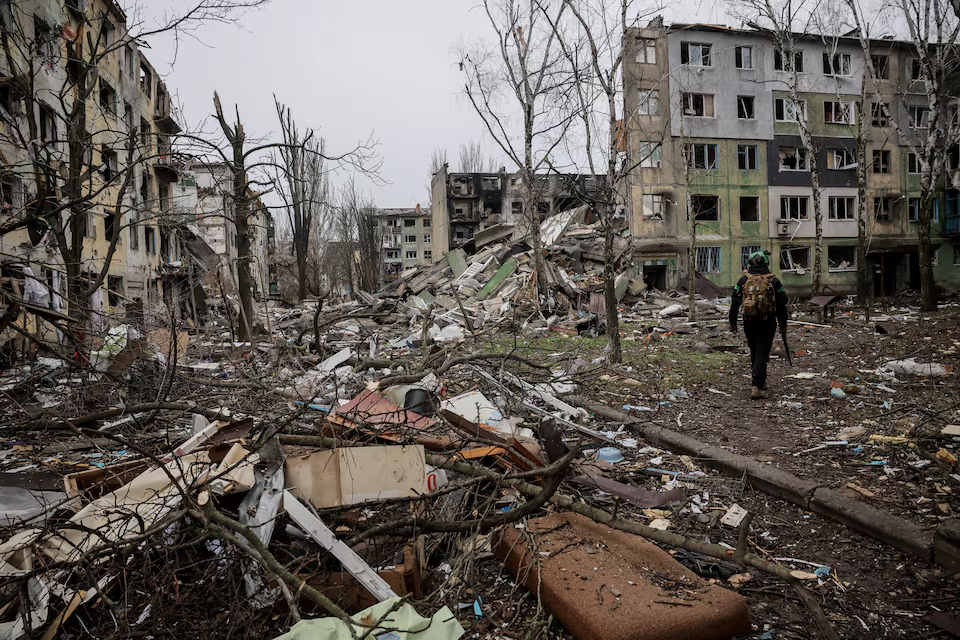
The renewed Ukraine peace talks between Kyiv and Washington signal a critical but uncomfortable phase in efforts to end Russia’s war against Ukraine. President Volodymyr Zelenskiy’s confirmation that negotiators will again confront territorial issues and the fate of the occupied Zaporizhzhia nuclear power plant underscores a reality many hoped to postpone: peace cannot be achieved without addressing the war’s most explosive questions.
At the core of the Ukraine peace talks lie two deeply intertwined dilemmas. The first concerns land—territory occupied by Russian forces and claimed by Ukraine as sovereign. The second concerns nuclear safety—specifically, who controls Europe’s largest nuclear power plant in an active conflict zone. Together, these issues represent not just bargaining points, but red lines that could determine whether peace is durable or dangerously fragile.
Ukraine Peace Talks and the Territorial Question: Why Land Remains Non-Negotiable
Territory is the most emotionally charged element in the Ukraine peace talks. For Ukraine, land is not a negotiable commodity but a matter of sovereignty, identity, and international law. Any concession risks legitimizing military aggression and setting a precedent that borders can be redrawn by force.
From Kyiv’s perspective, agreeing to territorial loss would undermine the sacrifices made since the invasion began and weaken Ukraine’s long-term security. Public opinion within Ukraine remains strongly opposed to ceding land, making compromise politically hazardous for any Ukrainian leadership.
Yet within the Ukraine peace talks, territorial realities on the ground cannot be ignored. Russia currently occupies significant portions of Ukrainian territory, and reclaiming them militarily carries immense human and economic costs. This creates a painful dilemma: can peace exist without justice, or does justice require prolonged war?
Ukraine Peace Talks and the Zaporizhzhia Nuclear Power Plant Crisis
No element of the Ukraine peace talks is as technically dangerous—or symbolically alarming—as the Zaporizhzhia nuclear power plant. Occupied by Russian forces, the facility has repeatedly raised fears of nuclear accidents, sabotage, or escalation.
Unlike territorial disputes, nuclear safety is not a zero-sum issue. A nuclear disaster would not respect borders, alliances, or ceasefires. Radiation release would affect Ukraine, Russia, and much of Europe, transforming a regional war into a continental crisis.
This makes the Zaporizhzhia issue uniquely sensitive within the Ukraine peace talks. Control, management, and demilitarization of the plant are not merely political questions; they are existential ones. Any agreement that fails to guarantee independent oversight and safety protocols risks catastrophic consequences.
Ukraine Peace Talks and the Role of the United States
The United States plays a decisive role in shaping the Ukraine peace talks, both as Ukraine’s principal military supporter and as a global diplomatic actor. Washington’s involvement signals seriousness, but it also introduces strategic calculations that extend beyond Ukraine itself.
For the U.S., the Ukraine peace talks are about more than ending one war. They touch on broader concerns: deterrence, credibility, NATO unity, and the message sent to other revisionist powers. Encouraging a settlement that appears to reward aggression could undermine long-standing security principles.
At the same time, prolonged conflict drains resources, escalates global instability, and heightens the risk of direct confrontation between nuclear-armed states. U.S. diplomacy must therefore balance support for Ukraine’s sovereignty with a pragmatic assessment of escalation risks.
Ukraine Peace Talks and International Law: A Precedent Under Scrutiny
International law looms large over the Ukraine peace talks. The principles of territorial integrity and sovereign equality are foundational to the post–World War II order. Allowing territorial changes under military occupation would weaken these norms.
This is why many observers view the Ukraine peace talks as a test case. If borders can be altered through sustained force and then ratified through negotiation, other conflicts may follow similar paths. The implications extend far beyond Eastern Europe.
Conversely, insisting on absolute restoration of borders may prolong conflict indefinitely. The Ukraine peace talks thus expose a troubling gap between legal ideals and geopolitical realities.
Ukraine Peace Talks and Nuclear Security Beyond Ukraine
The Zaporizhzhia issue elevates the Ukraine peace talks into the realm of global nuclear governance. Nuclear power plants were never designed to operate under military occupation, and existing international frameworks offer limited guidance for such scenarios.
The International Atomic Energy Agency (IAEA) has called for demilitarized safety zones, but enforcement remains elusive. Within the Ukraine peace talks, questions arise about who guarantees compliance and what mechanisms ensure accountability.
Failure to resolve this issue responsibly could erode confidence in nuclear safety worldwide, especially in regions facing instability or conflict.
Ukraine Peace Talks and the Moral Hazard of Compromise
A persistent concern surrounding the Ukraine peace talks is moral hazard. If territorial occupation becomes a bargaining chip rather than a violation to be reversed, future aggressors may calculate that war pays—eventually.
Ukraine’s resistance has so far been framed as a defense of international norms. Any settlement perceived as coerced compromise risks reframing the war as a negotiated adjustment rather than a clear violation.
This moral dimension complicates diplomacy. Peace achieved at the cost of principle may prove unstable, inviting future conflict rather than preventing it.
Ukraine Peace Talks and Domestic Pressures in Kyiv
Inside Ukraine, the peace talks are closely watched by a population that has endured immense loss. Zelenskiy faces the challenge of navigating diplomacy without appearing to betray public trust.
Territorial concessions could fracture domestic unity, while prolonged war risks exhaustion and despair. The Ukraine peace talks therefore take place under intense internal pressure, where every compromise carries political and emotional weight.
This domestic dimension limits negotiators’ flexibility, even when strategic logic suggests pragmatism.
Ukraine Peace Talks and Russia’s Strategic Calculations
From Moscow’s perspective, the Ukraine peace talks are an opportunity to consolidate gains and seek international recognition of its control over occupied areas. Russia’s interest in the Zaporizhzhia plant may also be strategic, providing leverage and security advantages.
However, Russia also faces constraints: economic sanctions, military attrition, and diplomatic isolation. These pressures shape its negotiating posture, making compromise possible—but only if it aligns with broader strategic goals.
Understanding these calculations is essential to assessing whether the Ukraine peace talks can produce meaningful outcomes.
Ukraine Peace Talks and the Risk of a Frozen Conflict
One possible outcome of the Ukraine peace talks is a frozen conflict—ceasefire lines without full resolution. While such arrangements can reduce violence, they often entrench instability.
A frozen conflict around occupied territory and a nuclear facility would be especially dangerous. It would leave unresolved sovereignty questions alongside ongoing nuclear risk, creating a volatile status quo.
For Europe, this scenario is deeply concerning, as it prolongs insecurity on the continent’s eastern flank.
Ukraine Peace Talks and Europe’s Stake in the Outcome
Although the talks involve Ukraine and the U.S., Europe has a direct stake in their outcome. Territorial instability and nuclear risk threaten European security, energy markets, and political cohesion.
European states are therefore likely to push for solutions that prioritize nuclear safety and uphold international norms, even if this complicates negotiations.
The Ukraine peace talks thus reflect not just bilateral diplomacy, but a broader contest over Europe’s future security architecture.
Ukraine Peace Talks: Can Peace Be Both Realistic and Just?
The central tension within the Ukraine peace talks is whether peace can be both realistic and just. Addressing territorial disputes and nuclear safety is unavoidable, but how these issues are resolved will define the war’s legacy.
A peace that ignores sovereignty risks instability. A peace that ignores reality risks endless war. Navigating between these extremes requires diplomacy that is firm, creative, and deeply aware of long-term consequences.
Conclusion: What the Ukraine Peace Talks Ultimately Decide
The renewed Ukraine peace talks force the international community to confront its deepest contradictions. They demand answers to questions that have no easy solutions: how to stop war without rewarding aggression, how to protect nuclear safety amid conflict, and how to reconcile law with power.
Whether these talks lead to lasting peace or temporary pause will depend on how territory and the Zaporizhzhia nuclear plant are addressed—not as bargaining chips, but as foundations of future stability.
One question remains unresolved:
Can the Ukraine peace talks deliver an end to war that secures both peace and principle, or will compromise today create instability tomorrow?