




Introduction: A Stark Warning from the World’s Top Diplomat
When the Secretary-General of the United Nations publicly states that the United States believes its power matters more than international law, the accusation carries historic weight.
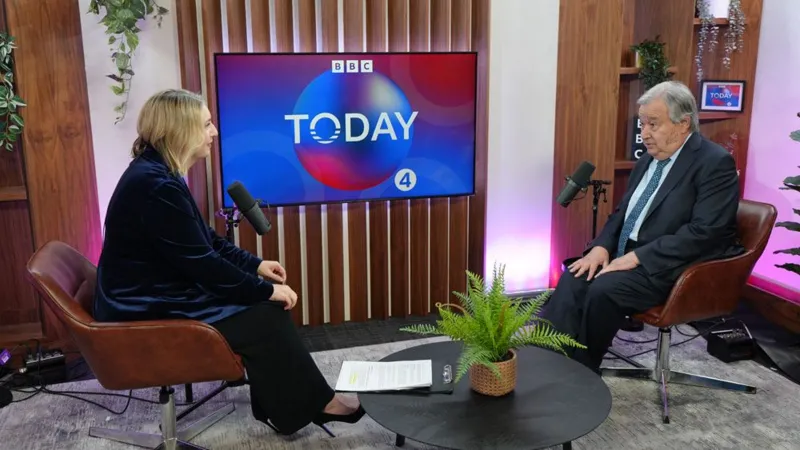
In an unusually candid interview with the BBC, António Guterres described a global order drifting away from the rule-based system established after World War II and toward a world governed by raw power. His words—“the power of law being replaced by the law of power”—were not rhetorical flourish. They were a diagnosis of a system he believes is breaking down in real time.
This article examines the deeper implications of Guterres’ remarks: the erosion of multilateralism, the credibility crisis of the United Nations, the behaviour of great powers—especially the United States—and what this means for international law, global stability, and the future of world governance.
The Post-1945 Order Under Strain
Why the UN Was Created
The United Nations was founded in 1945 to prevent a return to global catastrophe. Its core principles—sovereign equality, non-aggression, collective security, and respect for international law—were designed to constrain power, not legitimize it.
The UN Charter explicitly prohibits the use of force except in self-defense or with Security Council authorization
https://www.un.org/en/about-us/un-charter
For decades, this framework—while imperfect—created predictable norms. Today, Guterres argues, those norms are no longer respected by the very states that helped create them.
The United States and the Question of Impunity
Power Without Constraint
Guterres’ critique centers on what he describes as a “clear conviction” in Washington that multilateral solutions are irrelevant and that US power alone is sufficient to shape outcomes.
This perception has been reinforced by:
- Unilateral military actions
- Sanctions regimes imposed without UN approval
- Disregard for International Court of Justice rulings
Human rights organizations such as Human Rights Watch and Amnesty International have repeatedly criticized US actions that bypass international legal mechanisms
https://www.hrw.org/
https://www.amnesty.org/
From Exceptionalism to Erosion
The concept of American exceptionalism—the belief that the US operates by a different moral standard—has long existed. What is new, Guterres suggests, is the open dismissal of international law as a constraint.
This marks a shift from reluctant rule-breaking to unapologetic unilateralism.
Trump, the UN, and the Rejection of Multilateralism
“The UN Wasn’t There for Us”
Former President Donald Trump’s public disdain for the UN symbolized a broader rejection of multilateral institutions. His claim that he resolved conflicts without UN involvement reflects a worldview in which:
- Institutions slow action
- Rules restrict power
- Cooperation is optional
Political analysts at the Council on Foreign Relations note that this approach has weakened international coordination on security, climate change, and humanitarian crises
https://www.cfr.org/
The UN’s Structural Weakness: Power Without Enforcement
Why the UN “Has No Leverage”
Guterres’ admission that the UN lacks leverage is not new—but rarely has it been stated so plainly.
The UN can:
- Pass resolutions
- Issue condemnations
- Coordinate aid
But it cannot:
- Enforce compliance on great powers
- Prevent veto abuse
- Compel adherence to rulings
As the International Crisis Group explains, enforcement depends entirely on member states—especially powerful ones
https://www.crisisgroup.org/
The Security Council: Designed for 1945, Governing 2026
The Veto Problem
The UN Security Council’s permanent members—US, UK, France, China, and Russia—hold veto power that can block any resolution.
This has resulted in paralysis:
- Russia vetoing Ukraine-related resolutions
- The US vetoing Gaza ceasefire resolutions
The UN Department of Political and Peacebuilding Affairs acknowledges that veto use has increased dramatically since 2014
https://dppa.un.org/
A Question of Legitimacy
Guterres openly criticized the fact that three European countries hold permanent seats, while regions like Africa and Latin America remain unrepresented.
Scholars at Brookings Institution argue that this imbalance undermines the Council’s legitimacy in the Global South
https://www.brookings.edu/
Gaza: A Case Study in UN Powerlessness
Blocked Aid and Outsourced Humanitarianism
The war in Gaza illustrates the UN’s limitations starkly. Despite being the world’s largest humanitarian coordinator, the UN was prevented from delivering aid for long periods.
Israel’s decision to back alternative aid mechanisms—such as the Gaza Humanitarian Organisation—led to deadly consequences, with hundreds killed while attempting to access food.
The UN Office for the Coordination of Humanitarian Affairs (OCHA) documented systematic obstruction of aid access
https://www.unocha.org/
“We Were Ready—Provided We Had the Conditions”
Guterres’ defense highlights a fundamental truth:
The UN cannot act where states refuse cooperation.
Responsibility, therefore, lies not with the institution alone—but with those who restrict its ability to function.
The Global Drift Toward Power Politics
From Law-Based Order to Transactional World
Political theorists describe today’s system as moving toward neo-realist power competition, where rules apply only when convenient.
Indicators include:
- Territorial threats (e.g., Greenland)
- Regime change operations
- Selective enforcement of international law
The Stockholm International Peace Research Institute (SIPRI) notes rising militarization and declining arms control cooperation
https://www.sipri.org/
UN Reform: Necessary but Politically Blocked
What Reform Would Require
Guterres has repeatedly called for:
- Expanded Security Council membership
- Reduced veto use
- Greater representation for emerging powers
Yet reform requires approval from the very states that benefit most from the current structure.
The UN Reform Platform details decades of stalled proposals
https://www.un.org/en/reform
Is Multilateralism Dying—or Being Undermined?
Despite claims of its death, multilateralism persists in:
- Climate agreements
- Global health coordination
- Refugee protection
The Paris Climate Agreement, though fragile, demonstrates that collective action is still possible
https://unfccc.int/
The danger, Guterres warns, is not failure—but abandonment.
The Moral Test of the Powerful
“If We Don’t Confront the Powerful…”
Guterres’ closing statement underscores a moral dilemma:
- Should smaller states confront power at the risk of retaliation?
- Or remain silent and normalize impunity?
Legal scholars at International Law Association warn that selective law enforcement erodes the entire system
https://www.ila-hq.org/
Conclusion: A World at a Crossroads
The UN Secretary-General’s words reflect more than frustration—they signal a historic crossroads.
The question is no longer whether international law is perfect. It is whether law will survive power unchecked.
If powerful states continue to operate above the rules they helped create, international law risks becoming symbolic rather than binding—invoked by the weak, ignored by the strong.
The UN, flawed and constrained, remains one of the last global forums where power can still be challenged in the name of principle.
As Guterres reminds the world:
Silence in the face of power is not neutrality—it is complicity.