




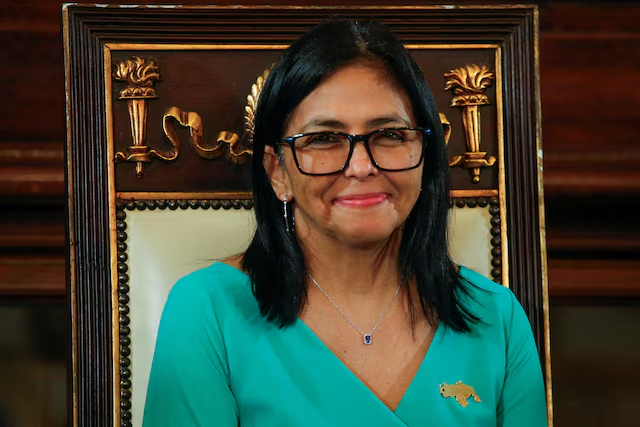
Venezuela Interim President
Introduction: The Rise of Delcy Rodriguez
On January 6, 2026, Russia officially welcomed the appointment of Delcy Rodriguez as Venezuela’s interim president, framing it as a decisive move to secure peace and stability in the face of “blatant neocolonial threats and foreign armed aggression.” This development is more than a simple leadership change — it is a clear example of how global politics, sovereignty, and foreign influence intersect in complex ways.
Delcy Rodriguez, previously vice president and a prominent political figure in Venezuela, now faces the daunting task of steering the country through turbulent waters. With Russia’s endorsement, the spotlight on Venezuela has intensified, raising questions about international alliances, intervention, and the future of governance in nations struggling with internal and external pressures.
Russia’s Support and the Language of Sovereignty
Russia’s backing of the Venezuela interim president highlights its strategic interest in the region and its emphasis on sovereignty. The Russian Foreign Ministry’s statement — insisting that “Venezuela must be guaranteed the right to determine its own destiny without any destructive external interference” — is not just diplomatic rhetoric.
For analysts, this signals a broader geopolitical contest. By supporting Rodriguez, Russia positions itself as a defender of national autonomy while implicitly criticizing countries that may seek to influence or destabilize Venezuela for strategic gains. This messaging resonates with nations worldwide, particularly in Africa and Latin America, which have historically contended with external pressures and interventions.
Neocolonial Threats and Foreign Interference: A Global Pattern
The term “neocolonial threats” is not accidental. It reflects a long-standing pattern in global politics where powerful nations exert influence over weaker states, often under the guise of diplomacy, aid, or economic support.
Venezuela’s situation mirrors challenges faced by many developing nations. The appointment of a Venezuela interim president amid foreign tension exemplifies how internal political processes can be directly impacted by external forces. In Africa, for instance, several countries have navigated similar challenges — balancing foreign investment, international partnerships, and political sovereignty. The global audience is increasingly attentive to these dynamics, as they raise questions about fairness, self-determination, and the true cost of international alliances.
Implications for Venezuela’s Future
Delcy Rodriguez inherits not only the presidency but also a complex international landscape. Her interim leadership carries several immediate implications:
- Diplomatic Relations: Strengthened ties with Russia could bolster Venezuela’s negotiating power but may strain relations with Western nations.
- Economic Stability: Foreign sanctions, investment, and aid will significantly shape the country’s recovery and growth prospects.
- Internal Governance: Balancing popular expectations, party loyalty, and political legitimacy is a challenging task for any interim leader.
By examining these factors, one can understand that the title of Venezuela interim president is more than ceremonial; it embodies responsibility, international scrutiny, and the burden of navigating geopolitical tensions.
Lessons for Africa and Emerging Nations
The Venezuelan scenario offers valuable lessons for African nations and other emerging economies. Issues like foreign interference, neocolonial pressures, and external economic influence are not unique to Latin America.
African leaders and policymakers can observe how global alliances — whether supportive like Russia’s stance or critical like some Western nations’ sanctions — affect domestic politics. This discussion highlights the importance of strengthening national institutions, promoting political transparency, and developing strategies to assert sovereignty in a world dominated by superpowers.
Public Response and International Reactions
Public opinion in Venezuela is split, as it often is in politically polarized countries. Supporters of Rodriguez argue that a Venezuela interim president endorsed by an international ally like Russia represents hope for stability. Critics, however, view external backing as a potential compromise of independence.
Internationally, reactions have been mixed. Some nations commend Russia for defending Venezuela’s sovereignty, while others express concern over the growing influence of foreign powers in Latin American politics. For global observers, this creates a fertile ground for discussion: what does sovereignty mean in the modern era, and can any nation remain truly independent of external influence?
Conclusion: Sovereignty, Stability, and Reflection
The appointment of Delcy Rodriguez as Venezuela interim president serves as a microcosm of larger geopolitical tensions. It demonstrates how leadership decisions, foreign alliances, and global narratives intertwine to shape national destiny.
For readers, the key takeaway is clear: sovereignty is a complex concept that demands vigilance, strategic partnerships, and awareness of historical patterns. Rodriguez’s presidency, whether temporary or extended, will offer critical insights into how nations navigate power, influence, and identity in the 21st century.
Questions
In a world of growing geopolitical tension, how can interim leaders assert independence while maintaining international partnerships?
How should nations balance foreign alliances with the need for political sovereignty?
Can the support of a powerful ally like Russia truly guarantee stability for Venezuela?
What lessons can African and emerging nations draw from Venezuela’s current political situation?