





Venezuela War:
1. Introduction: Tensions and Clarifications
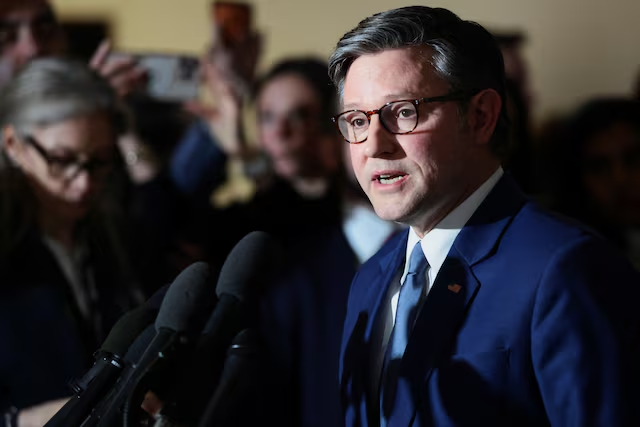
Recent statements by U.S. Republican lawmakers have clarified that the United States does not plan to occupy or nation-build in Venezuela. Following a briefing on January 5, 2026, top officials emphasized that the country’s armed forces are not present in Venezuela and that President Donald Trump’s administration does not envision an “endless war” in the region.
This clarification comes at a time of heightened international attention on Venezuela, following political transitions and ongoing debates about sovereignty, foreign intervention, and geopolitical influence. While tensions remain, the U.S. insistence on avoiding military engagement provides an important context for understanding the evolving situation.
2. The U.S. Stance on Venezuela: Avoiding an ‘Endless War’
Republican lawmakers, including House Speaker Mike Johnson and Secretary of State Marco Rubio, stressed that Washington’s approach is cautious and strategic. By avoiding direct military involvement, the U.S. aims to maintain influence in the region without escalating conflict.
This stance highlights a key aspect of modern diplomacy: balancing national interests with global perception. Ensuring that the Venezuela war does not escalate allows the U.S. to project stability, reassure allies, and manage its reputation on the international stage. Moreover, it underscores the administration’s commitment to indirect influence rather than overt occupation.
3. Sovereignty and Foreign Intervention: Lessons from Venezuela
The situation in Venezuela is a potent reminder of the delicate balance between sovereignty and external influence. Nations often navigate pressures from powerful allies or adversaries while attempting to assert control over their political destinies.
Avoiding direct military intervention in Venezuela reflects an acknowledgment that sovereignty matters in international relations. For global readers, this raises larger questions: How should countries respect another nation’s autonomy while safeguarding their strategic interests? What are the long-term consequences of intervention, even if initially intended to stabilize a region?
4. Potential Implications for Latin America and Beyond
The U.S. decision to avoid direct occupation has implications not just for Venezuela but for Latin America as a whole. Other nations in the region observe these developments closely, assessing potential shifts in alliances, trade, and security policies.
- Diplomatic Relations: Avoiding military engagement can preserve bilateral and multilateral relationships, reducing the risk of regional destabilization.
- Political Influence: Soft power, sanctions, and economic diplomacy may become the primary tools for shaping outcomes in Venezuela.
- Regional Stability: Latin American countries benefit from a measured approach that prioritizes negotiation over confrontation, signaling that external powers are committed to non-violent strategies.
5. Historical Context: U.S. Military Involvement Abroad
Understanding the current stance requires historical context. U.S. involvement in foreign nations has often been controversial, with interventions in Iraq, Afghanistan, and elsewhere demonstrating the long-term costs of military action. By emphasizing that no “endless war” is planned, Republican lawmakers appear mindful of these lessons.
In the past, military occupation has led to complex political, economic, and social consequences. In Venezuela, the administration’s caution may be intended to prevent repeating past mistakes, signaling to the world that strategic restraint is a deliberate choice.
6. Public Perception and International Reactions
Public opinion in the United States and abroad is varied. Many citizens welcome assurances that the U.S. will avoid direct conflict, while others remain skeptical of political rhetoric. International observers, particularly in Latin America, monitor U.S. policy closely, as actions—or inactions—have wide-reaching effects.
Global analysts recognize that statements about avoiding war can serve multiple purposes: reassuring allies, signaling restraint to adversaries, and managing domestic expectations. The discourse surrounding the Venezuela war demonstrates the complexity of modern diplomacy in an interconnected world.
7. Conclusion: Navigating Global Politics Without Escalation
The U.S. insistence that no “endless war” looms in Venezuela highlights a strategic approach that favors diplomacy, influence, and measured intervention. For global audiences, this serves as an example of navigating international relations with restraint while still safeguarding national interests.
Ultimately, the situation underscores the importance of thoughtful foreign policy decisions, the need to respect sovereignty, and the value of maintaining global stability. How nations respond to crises like Venezuela shapes not only regional dynamics but also broader international perceptions and alliances.
8. Reader Questions (Engagement Boosters)
To spark discussion and engagement on your blog, you can end the post with questions like:
- What is the most effective way for powerful nations to influence foreign policy without violating sovereignty?
- Can diplomacy and strategic restraint prevent conflicts like the Venezuela war from escalating?
- How do historical interventions shape current perceptions of U.S. foreign policy?
- Should other nations play a role in mediating Venezuela’s political and security challenges?