









Winter Storm Chaos in the US: 100+ Vehicle Pile-Up Exposes Dangerous Limits of Road Safety
The winter storm vehicle pile-up in the US that left more than 100 vehicles smashed together on a Michigan interstate is more than a weather-related traffic accident. It is a stark warning about the growing vulnerability of modern transportation systems in an era of increasingly volatile climate conditions.
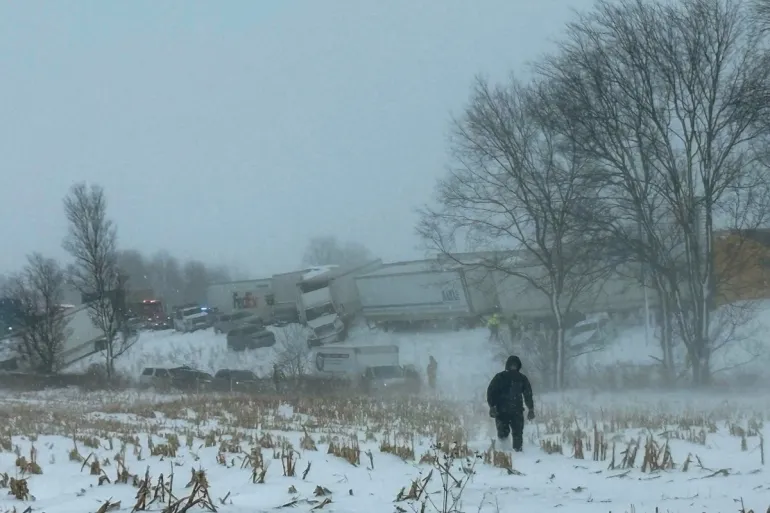
As snowstorms intensified across multiple states, a single stretch of Interstate 196 near Grand Rapids became a frozen bottleneck where cars, trucks, and trailers collided or slid uncontrollably into one another. While authorities confirmed no fatalities, dozens of motorists were injured, hundreds were stranded, and emergency services were stretched thin in sub-zero conditions.
This incident is not isolated. It represents a broader pattern of systemic risk—where climate volatility, infrastructure limitations, and human behaviour intersect with devastating consequences.
What Happened in Michigan: Anatomy of a Highway Disaster
According to the Michigan State Police, the pile-up occurred as heavy snowfall combined with strong winds, creating near whiteout conditions. Visibility dropped dramatically within minutes, leaving drivers unable to see vehicles slowing or stopping ahead.
More than 30 heavy goods vehicles were involved, compounding the severity of the crash. Large trucks require longer braking distances, and on ice-covered roads, even low speeds can be fatal.
Eyewitness accounts described a chilling sequence of events: vehicles slowing, then sliding; brakes failing to grip; impacts echoing through the storm as drivers realised they were powerless to stop.
State authorities closed both directions of Interstate 196, underscoring the scale of disruption and the danger of further collisions.
Why Multi-Vehicle Pile-Ups Are So Deadly
Multi-vehicle pile-ups are among the most dangerous road incidents because they are non-linear events. One initial loss of control rapidly escalates into dozens of secondary impacts.
Key contributing factors include:
- Reduced visibility from snow and blowing ice
- Ice formation that neutralises braking systems
- Driver overconfidence in vehicle safety technology
- Traffic density on major interstates
According to the US Federal Highway Administration, weather-related crashes account for nearly 21% of all vehicle accidents annually, with snow and ice responsible for over 1,300 deaths per year
(Source: https://www.fhwa.dot.gov/publications/research/safety/16040/)
Emergency Response Under Extreme Conditions
Responding to mass-casualty incidents during winter storms presents extraordinary challenges.
Emergency vehicles often struggle to reach crash sites due to blocked lanes and hazardous road conditions. In Michigan, responders had to navigate twisted metal, jackknifed trucks, and stranded motorists—many at risk of hypothermia.
The US Centers for Disease Control and Prevention (CDC) warns that cold exposure during vehicle entrapment significantly increases the risk of cardiac events, frostbite, and psychological trauma
(Source: https://www.cdc.gov/disasters/winter/index.html)
These conditions turn rescue operations into race-against-time scenarios where survival depends on rapid access and coordination.
The Role of Climate Volatility
While winter storms are not new, their intensity and unpredictability are increasing.
Climate research from the National Oceanic and Atmospheric Administration (NOAA) indicates that warming Arctic temperatures are disrupting jet stream patterns, leading to more frequent and severe winter weather events across North America
(Source: https://www.noaa.gov/education/resource-collections/climate/climate-change-impacts)
This volatility creates sudden transitions from manageable driving conditions to extreme danger—often without sufficient warning.
Infrastructure designed decades ago for more stable climate patterns is now facing stress it was never engineered to handle.
Psychological Factors: Why Drivers Keep Going
One of the most overlooked elements in winter storm accidents is driver psychology.
Studies in transportation psychology show that drivers often underestimate risk due to:
- Familiarity with a route
- Pressure to reach destinations
- False confidence in all-wheel drive or safety tech
Research published by the National Safety Council highlights that driver decision-making deteriorates significantly in low-visibility environments, increasing reaction times and risk-taking behaviour
(Source: https://www.nsc.org/road/safety-topics/driving-at-night-or-bad-weather)
This psychological gap between perceived control and actual conditions is a key reason why pile-ups grow so rapidly.
Economic and Infrastructure Implications
Highway closures caused by major pile-ups have cascading economic effects:
- Delayed freight and supply chains
- Lost productivity
- Increased insurance claims
- Public expenditure on emergency response and repairs
The American Transportation Research Institute estimates that weather-related highway disruptions cost the US economy billions of dollars annually
(Source: https://truckingresearch.org/)
As climate volatility increases, these costs are expected to rise—raising questions about infrastructure resilience and policy preparedness.
Government Warnings and Public Responsibility
The US National Weather Service issued multiple warnings ahead of the storm, cautioning motorists to avoid non-essential travel. Yet, as in many similar events, roads remained busy.
This highlights a persistent gap between official warnings and public compliance.
Travel safety advisories stress that reducing speed alone is insufficient; avoiding travel altogether during severe storms is often the safest option
(Source: https://www.weather.gov/safety/winter)
Lessons from the Michigan Pile-Up
The Michigan winter storm pile-up underscores several urgent lessons:
- Modern transport systems remain highly vulnerable to extreme weather
- Emergency response capacity has limits under climate stress
- Public risk perception often lags behind real danger
- Climate volatility is no longer a future concern—it is a present threat
Without improved infrastructure adaptation, better public communication, and stronger compliance with safety advisories, similar incidents are likely to become more frequent.
Conclusion: A Warning on Ice
The winter storm vehicle pile-up in the US is not just a traffic incident—it is a mirror reflecting broader vulnerabilities in climate resilience, public behaviour, and infrastructure planning.
As extreme weather events intensify, the margin for error on the road continues to shrink. The Michigan crash serves as a sobering reminder that no vehicle, technology, or experience level can override the laws of physics when ice and snow take control.
In an age of climate uncertainty, survival increasingly depends not on speed or confidence—but on restraint, preparation, and respect for nature’s limits.