









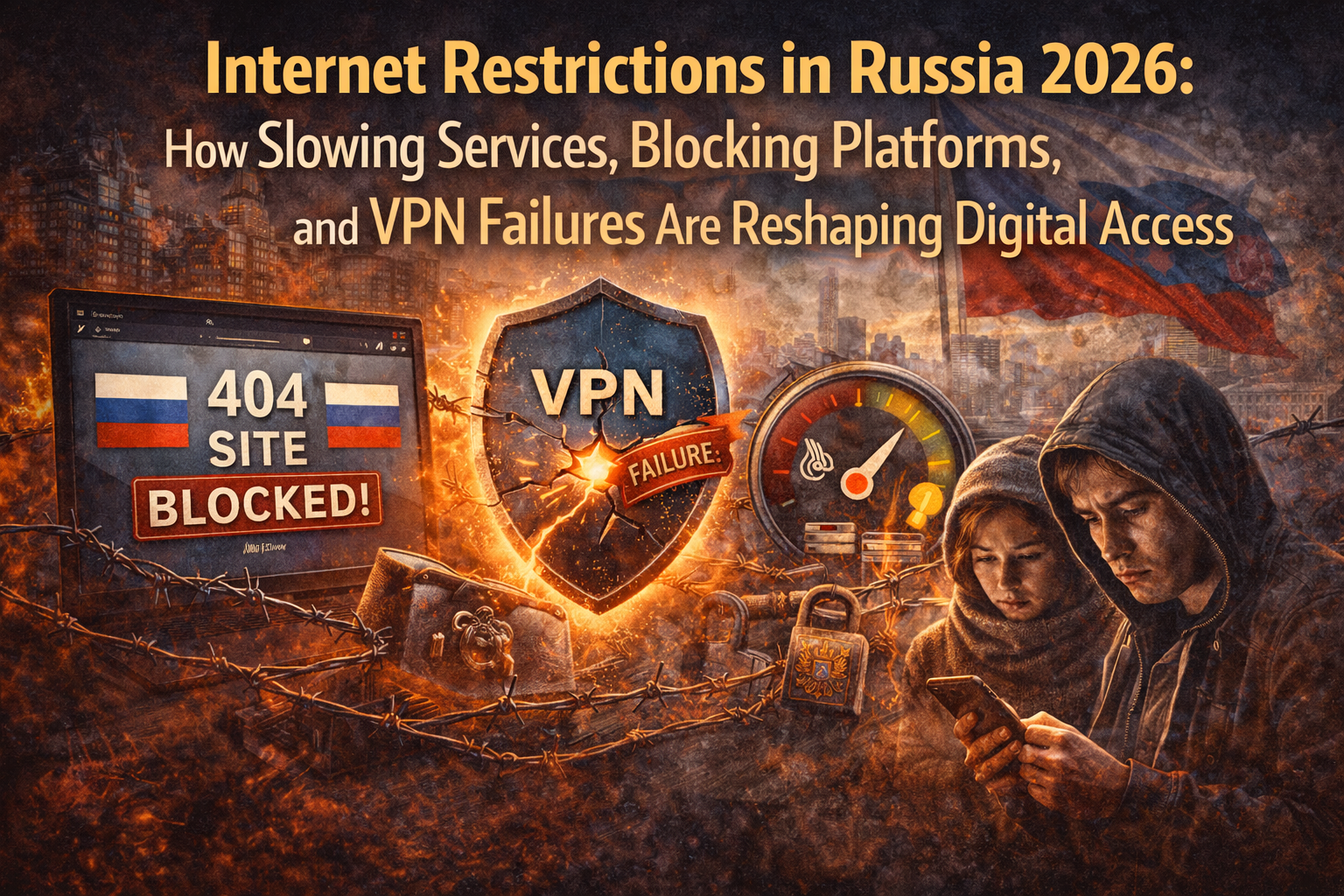
Russia internet restrictions are entering a new and more disruptive phase, as users report slowing services, blocked platforms, and unreliable VPN access. What was once a technical workaround for bypassing censorship is becoming increasingly ineffective, reflecting the government’s growing technical capability to control national internet infrastructure.
This shift represents more than routine censorship—it signals the maturation of Russia’s sovereign internet model, designed to centralize digital control, reduce reliance on foreign infrastructure, and strengthen state authority over information flows.
According to the Library of Congress analysis of Russia’s sovereign internet legislation, the government created centralized infrastructure enabling authorities to reroute or restrict internet traffic during security threats or political crises (Library of Congress:).
Russia Internet Restrictions and the Rise of Digital Sovereignty
Russia internet restrictions stem from the broader concept of digital sovereignty—the ability of a nation to independently control its digital infrastructure, platforms, and data flows without external influence.
This policy framework accelerated following geopolitical tensions, sanctions, and increasing concerns about foreign influence through global technology platforms.
Research from the Carnegie Endowment for International Peace explains that Russia’s sovereign internet strategy aims to create infrastructure capable of operating independently from the global internet if necessary (Carnegie Endowment:).
This system allows authorities to:
- Control traffic routing nationally
- Block foreign platforms selectively
- Monitor communications more efficiently
- Restrict circumvention tools such as VPNs
Such capabilities significantly strengthen the state’s influence over digital access.
Why VPNs Are No Longer Reliable Under Russia Internet Restrictions
Virtual Private Networks (VPNs) were once the primary method for bypassing Russia internet restrictions. However, authorities now deploy advanced network monitoring systems capable of identifying and disrupting VPN traffic.
One key technology used is deep packet inspection (DPI), which allows internet service providers to analyze and filter data packets based on content and origin (Cloudflare Learning Center:).
DPI enables authorities to:
- Detect VPN encryption signatures
- Slow VPN traffic intentionally
- Block known VPN servers
- Disrupt encrypted connections
This explains why many users experience unstable VPN performance or frequent disconnections.
Infrastructure-Level Control: The Most Powerful Form of Internet Restriction
Unlike traditional censorship methods targeting individual platforms, Russia internet restrictions increasingly operate at the infrastructure level.
This includes control over:
- Internet exchange points
- National telecom routing systems
- Internet service provider infrastructure
- Domain name resolution systems
Freedom House reports that Russia has significantly expanded technical measures to control internet access, strengthening its ability to isolate its network from global systems if required (Freedom House:).
Infrastructure-level control is far more effective than platform-level censorship because it allows authorities to restrict access regardless of user behavior.
Psychological and Social Effects of Persistent Internet Restrictions
Russia internet restrictions are not only technical—they also produce psychological and social consequences.
Users experience:
- Digital frustration and fatigue
- Reduced trust in technology reliability
- Increased sense of isolation from global information
- Greater dependence on state-approved platforms
Over time, these effects reshape digital habits, encouraging behavioral adaptation aligned with national infrastructure limitations.
This phenomenon reflects a broader shift from open internet access toward controlled digital environments.
Russia Internet Restrictions and Global Internet Fragmentation
Russia internet restrictions are part of a wider global trend toward internet fragmentation, sometimes called the “splinternet.”
According to Access Now, governments worldwide are increasingly implementing network shutdowns, traffic filtering, and platform restrictions (Access Now Internet Shutdown Tracker: ).
This fragmentation creates multiple national internet systems rather than a unified global network.
Consequences include:
- Reduced global connectivity
- Increased regional digital isolation
- Higher technical barriers for cross-border communication
- New geopolitical tensions in cyberspace
Russia represents one of the most advanced examples of national internet control implementation.
Technical Evolution Behind Russia Internet Restrictions
Russia’s digital control capabilities have evolved significantly over the past decade.
Key technological developments include:
Centralized Traffic Routing
Authorities can reroute traffic through state-controlled nodes.
VPN Signature Detection
Encrypted connections can be identified and blocked automatically.
Traffic Throttling
Connection speeds can be slowed selectively without full shutdown.
Platform-Level Filtering
Specific applications or services can be restricted dynamically.
These tools provide flexible and scalable internet control.
Why Authorities Slow Services Instead of Blocking Them Completely
Slowing services—known as throttling—is often more effective than outright blocking.
This strategy:
- Reduces public backlash
- Creates uncertainty rather than direct confrontation
- Gradually discourages use of restricted platforms
- Maintains plausible technical explanations
Throttling also allows authorities to adjust restrictions dynamically without triggering widespread disruption.
Future Outlook: Increasing Digital Sovereignty Worldwide
Russia internet restrictions reflect a long-term transformation in global internet governance.
More nations are developing independent internet infrastructure to:
- Protect national security
- Reduce foreign technological dependence
- Strengthen information sovereignty
- Control digital influence
This shift represents one of the most significant structural changes in the internet since its creation.
Rather than disappearing, Russia internet restrictions are likely to expand and become more technically sophisticated over time.
Conclusion: Russia Internet Restrictions Signal a New Era of Controlled Connectivity
Russia internet restrictions demonstrate how modern governments can reshape digital access through infrastructure, technology, and policy.
As VPNs become less effective and infrastructure control expands, the internet is evolving from a globally unified system into a collection of nationally controlled networks.
This transformation marks the emergence of digital sovereignty as a defining feature of modern geopolitics.
For users, the experience may feel frustrating and restrictive. For policymakers, it represents a powerful tool for shaping national information environments.
For the world, it signals the beginning of a more fragmented digital future.